

TLDR: When a friend’s loved one gets a cancer diagnosis, the best treatment for their specific tumor may already exist. The hard part is finding it in time. Two companies I’ve gotten to know are closing that gap from opposite ends: an AI navigator that reads your entire medical record against the latest research, and a Swiss group taking genome sequencing to $100 while building “torpedo” molecules that deliver radiation straight to tumor cells.
Being in the longevity field, I regularly get emails from friends asking for advice for loved ones who have cancer. It crushes me not to have an answer. So when I came across two powerful options, I wanted to share them with the world.
Here’s my honest problem with those emails. Every cancer is different. The right answer for one person is wrong for the next, and I’m not that person’s oncologist. What I can do is point people toward tools and science that tilt the odds in their favor. That’s what this blog is about.
THE GAP BETWEEN WHAT’S POSSIBLE AND WHAT PATIENTS GET
Cancer research is moving exponentially. Cancer care, for most people, is not.
According to CureWise, 1.3 million new papers were published in PubMed last year, more than 3,500 a day. No physician can keep up with that. So most patients are treated according to guidelines written years ago, based on the average patient in a clinical trial.
Steve Brown, the founder of CureWise, and a member of my Abundance community, put it to me bluntly when we spoke last week. He described being placed on a guideline-driven regimen built around drugs that were “30, 40, 50 years old.” Meanwhile, the science behind precision oncology had moved far ahead.
“In cancer, 18 million people have 18 million different diseases.”
-Steve Brown, CEO, CureWise
That line, from an interview Steve gave to WeWillCure, is the whole problem in a sentence. We lump unique diseases together and treat them with blunt instruments. The two companies below attack that problem from opposite ends: one helps you find the right treatment, and the other helps you find the cancer earlier and hit it more precisely.
OPTION 1: CUREWISE, AN AI NAVIGATOR FOR YOUR CANCER
Steve Brown is a physicist and computer scientist (Stanford) who founded Health Hero Network two decades ago and helped invent remote patient monitoring. He holds more than 200 patents in health technology and AI.
In January 2025, the Palisades fire destroyed his home. He’s said since then that the fire saved his life.
For months before that, at age 60, he’d been losing weight, feeling drained and losing his appetite. He pushed for every test: scans, colonoscopy, endoscopy, cardiac workups. His cardiologist called it a fishing expedition and suggested stress. After the fire, displaced to Palm Desert, a bout of severe pain put him in an emergency room with doctors who had no preconceptions. Within days they found an aggressive blood cancer in his bone marrow.
Then Steve did what builders do. He built an AI medical agent and fed it the exact same data his earlier doctors had seen: his history, labs, imaging and notes. In his words, “Within moments it flagged what everyone had missed, and recommended specific tests no human had suggested.”
It got more interesting from there. When he analyzed the DNA of his cancer cells with his AI agents, he found genetic variants suggesting the standard treatment would likely work less well for him. The analysis pointed to an off-label drug combination with strong evidence for his tumor profile. It took persistence and several second opinions to convince his care team, and he describes the result as a rapid and sustained complete response.
CureWise is the tool he built so that nobody else has to code their own swarm of AI agents while fighting for their life. Here’s what it does today:
It unifies your records. It pulls your documents electronically from thousands of US health systems into one medical record. Steve told me this is the single biggest hurdle, because most patients’ data is scattered across institutions.
It runs a virtual tumor board. Hospitals use tumor boards, where specialists from different fields debate a complex case. CureWise uses multiple AI agents that think like different specialists, then looks for where their answers converge.
It matches you to trials and research. It reads your data against the latest research and clinical trials to surface options beyond standard care.
It prepares you for appointments. You walk in with tailored questions and a brief you can share with your doctor.
It costs $49 a month (or $439 a year) after a seven-day free trial. CureWise is clear that it doesn’t replace your doctor; it’s an education and advocacy tool, not medical advice. Dr. Kinsey McCormick, a breast medical oncologist at Swedish, wrote that she used it to support a patient through complex treatment decisions and found it “an exceptionally valuable resource.”
Steve’s next step is a monitoring layer that lets nurses and case managers oversee patients day to day. That’s how a tool like this moves from motivated individual patients into health systems. (Note for disclosure: while I’m a supporter of Curewise, I am not currently a shareholder).
OPTION 2: SWISS ROCKETS, FROM $100 GENOMES TO “TORPEDO” MOLECULES
Dr. Vladimir Cmiljanovic grew up in Serbia and moved to Switzerland as a teenager. His grandmother died of leukemia. His mother, Mira, died of pancreatic cancer. When he was a child, he promised her he’d cure cancer.
He and his sister, also a medicinal chemist, have spent their careers on that promise. As a student in Basel, he walked into the office of Professor Mike Hall, who discovered the target of rapamycin, better known today as mTOR. That line of research fed into a collaboration with Novartis that helped lead to everolimus (Afinitor), approved for kidney cancer in 2009.
Vlad then spent seven years designing a single molecule that blocks both mTOR and its “twin brother” enzyme, PI3K, which together control a cancer cell’s growth and its sugar supply. He named it bimiralisib, after his mother, Mira. In a 46-patient Phase 2 trial for actinic keratosis (a common precancerous skin condition), a topical gel version cleared 71% of patients in the four-week group and 92% of the mildest lesions, with mostly mild skin reactions (EADV Congress, 2025).
The work I find most exciting is two other things Swiss Rockets is doing.
The first is radioligand therapy, which Vlad calls “torpedo” molecules. A molecule designed to find a protein that appears only on the surface of cancer cells is injected into the bloodstream. First, you attach a diagnostic isotope (gallium-68), so a PET scan lights up every tumor. Then you swap in a killing isotope and send the same molecule back to deliver radiation directly to those cells. Doctors call it theranostics: you treat what you see, and you see what you treat.
The first generation of this approach, using lutetium-177, is already FDA-approved for advanced prostate cancer. Vlad’s wife, Nadja, a nuclear pharmacist, has been a pioneer of the next-generation isotope, terbium-161, which also emits short-range Auger electrons that pack more destructive power into individual cancer cells. In the first human trial of terbium-161 (VIOLET, Peter MacCallum Cancer Centre, published in Lancet Oncology in 2025), 70% of 30 men with metastatic prostate cancer saw their PSA drop by at least half, with minimal severe side effects. Vlad says European regulators have now cleared Swiss Rockets to test it as a first-line therapy for high-risk prostate cancer, with a trial starting within weeks (company-reported).
“We treat what we see, and we see what we treat.”
The second is cheap, routine genome sequencing. In February, Swiss Rockets signed a definitive agreement to acquire Complete Genomics, a pioneer of next-generation sequencing founded by Dr. Rade Drmanac. The deal has been approved by MGI’s shareholders and by Chinese regulators, with US approval expected this month.
Vlad says the combined company can sequence your complete genome and your complete transcriptome (which genes are active right now) for $100 each, and he’s aiming for $10 within two years. Your genome tells you what risks you inherited, and it only needs to be read once. Your transcriptome is the moving picture: a test you could repeat a couple of times a year to see whether a risky gene is switching on.
At the meeting I hosted, Vlad told the story of one of his investors whose genome revealed six high-risk genes, including BRCA2. A follow-up transcriptome showed prostate cancer pathways massively overexpressed. A standard ultrasound found nothing. A more sensitive micro-ultrasound found a small tumor, biopsy confirmed it, and it was treated while still tiny. It’s one person’s story, told by the company, but it shows the kind of detection they’re aiming for. Swiss Rockets is now taking early sign-ups for this testing through a program it calls Longevity Fingerprint.
(Note for disclosure: while I’m a supporter of SwissRockets, I am not currently a shareholder).
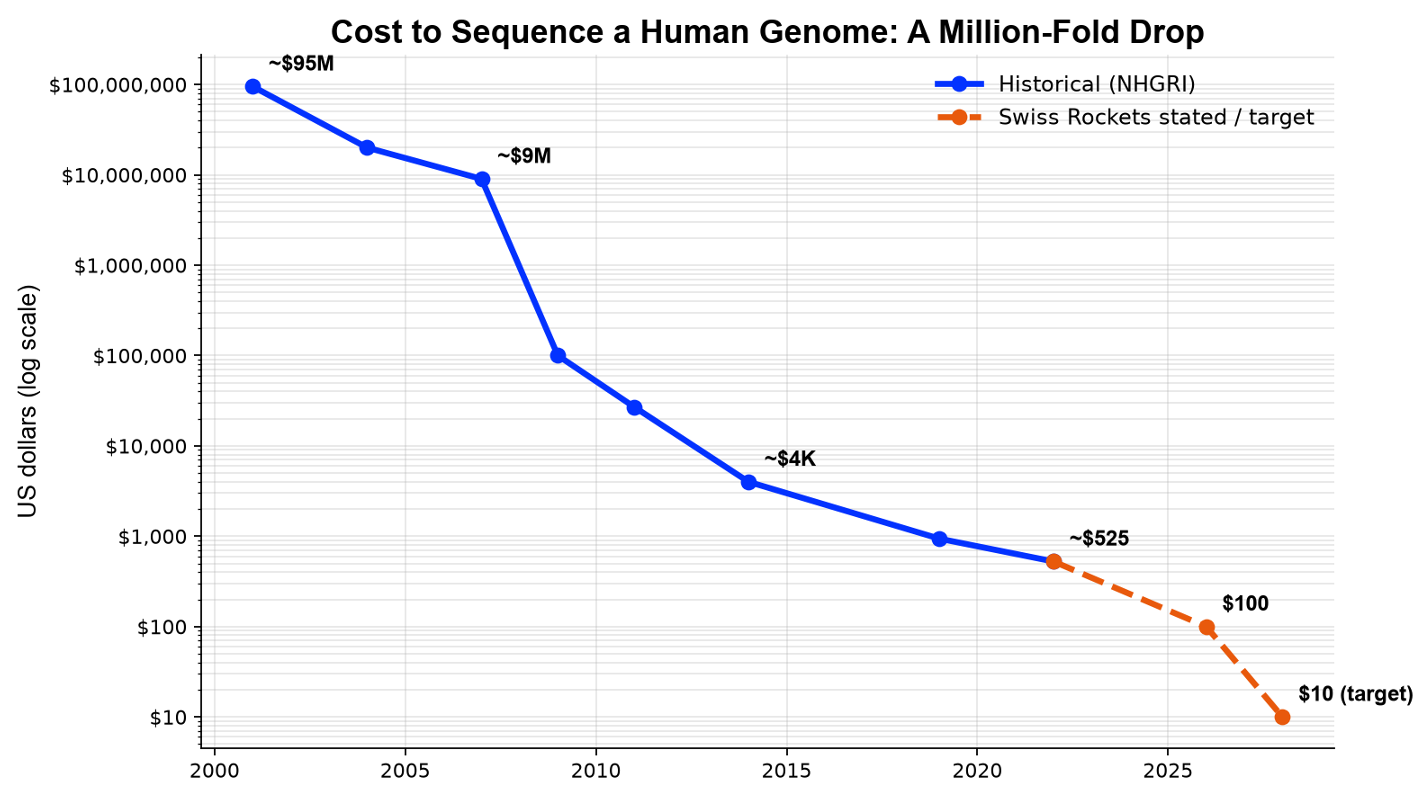
Approximate cost to sequence a human genome. 2001–2022: NHGRI. 2026 and 2028: Swiss Rockets’ stated price and target.
WHY THIS MATTERS: A MILLION-FOLD DROP
In 2001, sequencing a single human genome cost roughly $100 million, according to the National Human Genome Research Institute. If Swiss Rockets delivers on $100, that’s a million-fold drop in 25 years. Moore’s Law, doubling every two years, delivers a few thousand-fold over the same 25 years. Biology lapped it by a factor of a hundred or more.
When something gets a million times cheaper, it stops being a luxury for the rich and becomes a routine test, like a cholesterol panel. That’s the arc we saw with computing, solar and long-distance calls, and it’s now happening in diagnostics.
Put these two companies side by side and you can see where cancer care is heading. Cheap, repeated molecular monitoring catches disease years earlier. Precision drugs and radioligands hit it where it lives. And AI navigators make sure the patient and their doctor know about all of it.
WHAT I’D TELL A FRIEND TOMORROW
This is what I’ll say the next time one of those emails lands in my inbox. None of this is medical advice; it’s a list of questions worth asking your oncologist.
Get all of your records in one place. Every scan, pathology report and lab, from every institution.
Ask for genomic profiling of the tumor. Knowing the specific mutations driving a cancer can open up targeted drugs and clinical trials.
Ask about clinical trials, early. Not as a last resort after the standard options fail.
Get a second opinion at a major cancer center, especially for a rare or aggressive cancer.
Use AI to prepare. A tool like CureWise can help you show up with better questions.
For prostate cancer, ask about PSMA PET imaging and radioligand therapy.
Cancer has been with us throughout human history. For the first time, we can read the disease letter by letter, track it as it changes, and aim a therapy at the exact cells that need killing. The question I’m leaving you with is this: if a $100 test could tell you about a cancer years before any scan could see it, would you take it twice a year?
To a future of abundance,
Peter
Excited by this. Technological complexity is the classic Silicon Valley hard problem, and CureWise is pointing it at a real one: giving people who don’t understand healthcare, and didn’t necessarily want to, the agency to push their care team and, over time, the trust in themselves to manage their own care.
What would make it even more compelling is helping people figure out how to actually navigate the cost of that care. NORC at the University of Chicago estimated 20 million Americans have turned to crowdfunding to pay medical bills, and a University of Washington study found fewer than 12% of medical GoFundMes ever reach their goal. With the out-of-pocket max on a commercial plan rising to $12,000 for one person next year, and marketplace insurers denying one in five in-network claims, the cost of this care is as uncertain as the care plan itself.
A $49-a-month AI cancer navigator is helpful to a degree. But how do we make sure it also helps with what people fear most once they know what they're up against -- not being able to afford the care?
Answer: How could ANY reasonable person fail to find $200/year to know?? Especially with specific targeted treatment to follow any positive (even false-negative) report? The real need is to get insurance companies to pay for the individual-treatment...in that they usually claim stuff like that "unapproved/speculative/unproved/experimental" will not be paid. Getting the COST of treatment down where we can get it without insurance is vital.