

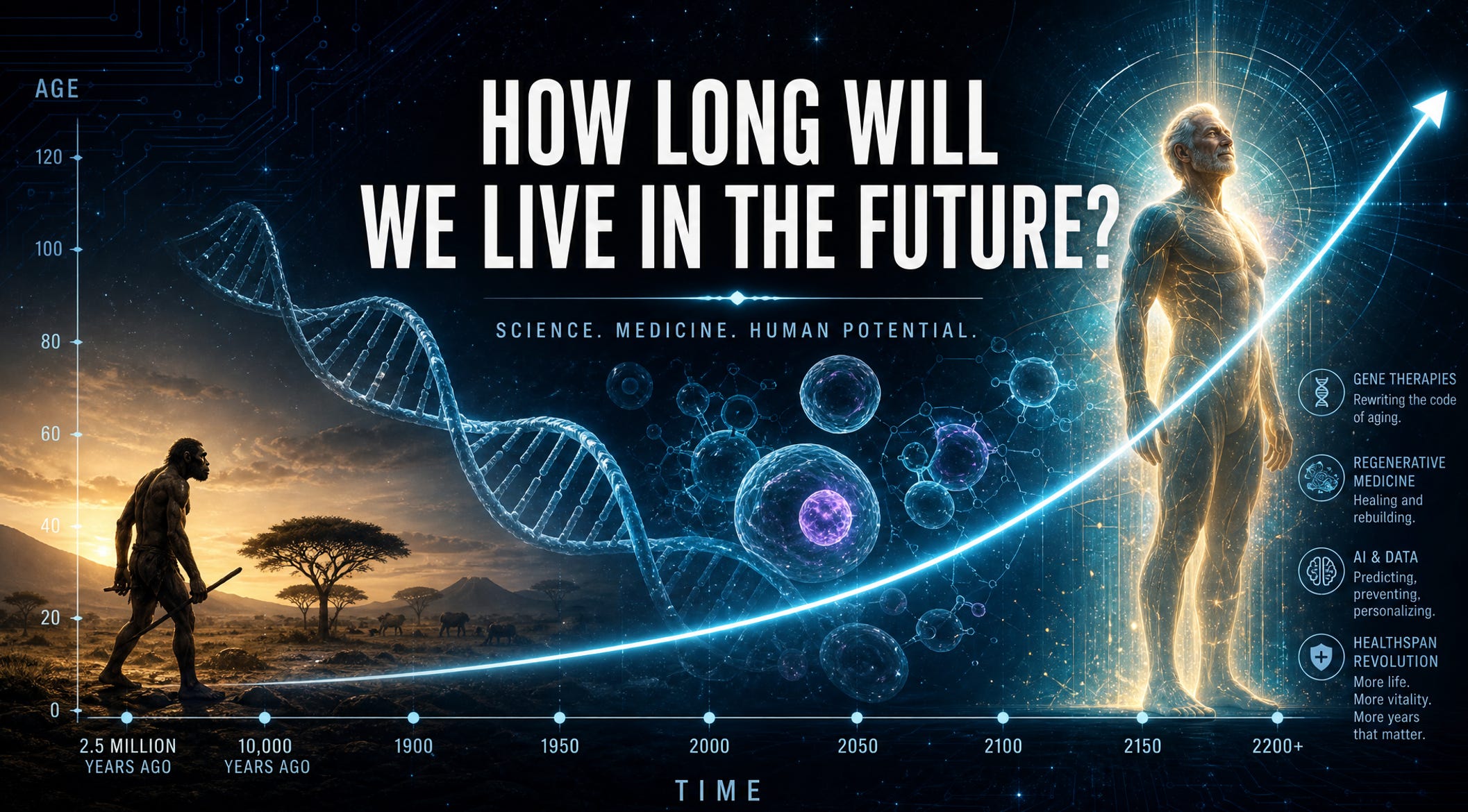
TLDR: Nature never designed us humans to live long. We were designed to reproduce, raise a few kids and get out of the way of the food supply. Every system in your body begins a slow decline that starts in your late twenties, right on schedule. For most of human history our lifespan hovered around 40. Then something changed. Life expectancy doubled in a century to 80, dipped during COVID, and is climbing again. Now AI and biotech might double that again.
HOW WE EVOLVED TO DIE
Homo sapiens showed up on the savannas of Africa roughly 200,000 years ago. Back then you’d hit puberty around 12 or 13. You had children almost immediately. By 27 or 28, if you’d survived that long, you were a grandparent. And here’s the brutal logic evolution ran on the African plains: food was scarce, and the surest way to doom your own grandchildren was to stick around eating the calories they needed to survive. So we didn’t stick around. We were built to peak in our late twenties, hand off our genes, and then die.
That schedule is still running inside you. Nobody turned it off. Look at what starts falling apart right after your reproductive prime:
Hormones: Testosterone in men drops about 1% every year starting around age 30. Growth hormone falls roughly 15% per decade after 20, a decline endocrinologists literally named “somatopause.” In women, estrogen holds and then falls off a cliff at menopause around 50. These aren’t symptoms of disease. They’re the factory settings.
The thymus: This is the one almost nobody knows about, and it matters more than any of them. The thymus is a small gland behind your breastbone, and it’s the school where your T-cells (the immune system’s trained soldiers) learn to fight. It hits peak output at puberty and then shrinks, a process called involution, until by middle age it’s gone, converted mostly to fat. That’s why a 20-year-old shrugs off a flu that can kill a 75-year-old.
Stem cells: The repair crews that replace worn-out cells shrink in number and lose their edge with every decade. Wounds heal slower. Tissues regenerate worse. The maintenance department gets understaffed. Stem cell numbers decline 10-fold in sometissues—while functional diversity in blood can collapse by 100- to 1,000-fold or more.
Muscle: Sarcopenia, the loss of muscle mass, runs at roughly 1% per year after 30 and accelerates later in life. Muscle isn’t just for looks; it’s a metabolic and longevity organ. Losing it predicts frailty, falls, and death.
“Evolution never cared whether you saw 80. It cared whether you reproduced by 25. Everything after that is a bonus the savanna never promised you.”
Add it up and you get a machine that peaks in its late twenties and then, absent any intervention, coasts downhill. Evolution optimized you for the savanna, not for Whole Foods, modern medicine, or a 90th birthday. The good news is that “the way we were built” and “the way we have to stay” are two very different statements.
THE CLIMB: FROM 40 TO 78
In the early 1800s, average life expectancy in the developed world sat around 40 years, dragged down by infant mortality, infectious disease, and childbirth.
Then came the greatest improvement in human wellbeing ever recorded, and almost nobody celebrates it. Sanitation, germ theory, antibiotics, vaccines, and modern medicine drove life expectancy in the United States from roughly 40 to nearly 79 in about a century and a half. During this 150 years, we doubled the human lifespan, adding roughly 3 months of life, for every year a person lived.
It wasn’t magic or gene therapy; it was clean water, soap, and penicillin. Keep that in mind when someone tells you doubling it again is impossible. We have a track record.
The climb wasn’t perfectly smooth. US life expectancy peaked at 78.8 years in 2019, then COVID knocked it down hard, to 76.4 by 2021, the steepest two-year drop in a century. But the system recovered fast. By 2023 it had climbed back to 78.4 and it’s still rising. The dip was real. The trend is up.
LONGEVITY ESCAPE VELOCITY
Now for the concept that changes the entire game. It’s called Longevity Escape Velocity, and it’s simple enough to explain at a dinner table.
Right now, every year you live, you spend roughly a year of your remaining life. The tank drains at the rate you’d expect. Longevity Escape Velocity, LEV, is the moment when medical science starts adding *more* than a year of healthy life expectancy for every calendar year that passes. Live through one year, and science hands back thirteen months. Cross that threshold and, for the first time, you’re gaining ground faster than you’re losing it. Aging stops being a countdown.
My friend Ray Kurzweil, one of the most accurate technology forecasters alive, predicts we reach LEV by 2033. Not immortality. Not a cure for death. Just the tipping point where the finish line starts moving away from you faster than you’re walking toward it. If Ray is right, and his track record on technology timelines is frankly embarrassing to his critics, then the single most important thing you can do is stay healthy enough, long enough, to make it onto the far side of that curve.
“Longevity Escape Velocity isn’t living forever. It’s science adding life faster than time takes it. Your only job is not to die from something stupid before LEV is achieved!”
THE ENGINE: WHERE BIOTECH MEETS AI
What makes 2033 credible instead of wishful is the collision happening right now between biotechnology and artificial intelligence. Your body is 40 trillion cells, each running up to 10 billion chemical reactions per second. No human mind, and no traditional lab, can model that. AI can. That’s the unlock.
The most exciting frontier is epigenetic reprogramming: resetting a cell’s biological age without changing its underlying DNA, using the Yamanaka factors that won Shinya Yamanaka a Nobel Prize. The idea is to reinstall the software on an aging cell, as David Sinclair puts it, rather than replace the hardware.
This is no longer theoretical. Life Biosciences, the company Sinclair co-founded, received FDA clearance and is running the world’s first human clinical trial of partial epigenetic reprogramming, their ER-100 therapy, on patients with glaucoma and a sudden-blindness condition called NAION. Because the endpoint is binary, a blind patient either sees again or doesn’t, results could arrive within months. As Sinclair told a global audience: “By this time next year, we will know if it works or not. And if it works, the eye is just the beginning.”
He’s not alone. NewLimit, co-founded by Coinbase CEO Brian Armstrong, raised a $435 million Series C in June 2026 at a $3.1 billion valuation to push its own age-reprogramming therapies toward human trials. Armstrong personally seeded the company with over $100 million of his own money. When operators who could do anything with their capital and reputation choose to bet both on reversing aging, pay attention to the signal.
“CURE ALL DISEASE” AND “DOUBLE THE LIFESPAN”
Here’s the part that still stops me cold, because it’s not coming from longevity enthusiasts. It’s coming from the people building the most powerful AI systems on the planet, and they are sober, credible, and not prone to hype for its own sake.
Demis Hassabis, the Nobel laureate who runs Google DeepMind, launched Isomorphic Labs on the back of his AlphaFold breakthrough with a stated goal I would have called science fiction a decade ago: to “cure all disease,” with AI-designed drugs he expects to be in clinical trials within a very short window. When the man whose AI solved protein folding says he’s aiming to cure all disease, that is not a motivational poster. It’s a roadmap.
And Dario Amodei, the CEO of Anthropic, wrote in his essay “Machines of Loving Grace” that powerful AI could compress a century of biological progress into five to ten years. His specific prediction: we could *double the human lifespan*, to around 150 years. His logic is exactly the historical argument I made earlier. We doubled it once in the 20th century, from 40 to nearly 80. Doubling it again to 150, he argues, is simply “on trend” once AI is doing the biology.
Two of the most serious people in artificial intelligence, independently, are telling us the same thing: the diseases of aging are an engineering problem, and the engineer just showed up.
THE $101M HEALTHSPAN XPRIZE
This is why we launched XPRIZE Healthspan, the largest competition in XPRIZE history: a $101 million, seven-year global prize challenging teams to do something that has never been done. The target is to restore 10 to 20 years of lost muscle, cognitive, and immune function in people aged 65 to 80, in a single year of treatment.
Read that again. We’re not paying for a slide deck or a mouse study. We’re paying for a therapy that takes a 75-year-old and gives them back the body and mind of someone 10 to 20 years younger, and proves it in a rigorous human trial. It’s the difference between adding years to your life and adding life to your years. Because a longer lifespan without a longer *healthspan* is just a longer decline, and that’s not the future any of us are working toward.
I’ve spent my career on a simple bet: what you incentivize, you accelerate. The Ansari XPRIZE told a generation that private spaceflight was real, and it launched an industry. XPRIZE Healthspan is that same bet, aimed at the oldest problem we’ve ever faced.
Evolution built you to bow out in your late twenties. Scripture set the ceiling at 120. Modern medicine already smashed the savanna’s plan and doubled our years once. Now AI and biotech are lined up to do it again, and the men building the machines are telling us the timeline is a decade, not a century.
So I’ll say it the way I said it at the Vatican. Let’s start at 120. Then let’s renegotiate.
WHAT THIS MEANS FOR YOU
If you’re an entrepreneur: The longevity market is where the internet was in 1994. AI just collapsed the cost of biological discovery by orders of magnitude, and the FDA is clearing reprogramming trials. If you’ve been waiting for a moonshot with a trillion-dollar TAM and a clear on-ramp, this is it.
If you’re an executive: Your most valuable people are going to work far longer than any retirement model assumes. Start thinking about 60-year careers, not 60-year-olds heading for the exit. The talent map is about to stretch.
If you’re an investor: Watch the reprogramming companies, Life Biosciences, NewLimit, Retro Biosciences and the AI-native drug labs like Insilico Medicine and Lila Sciences. The signal to trust is who the serious operators are putting their own capital behind, and right now they’re putting it here.
If you’re a student: The single highest-leverage skill of your lifetime is the intersection of AI and biology. You could be entering the field at the exact moment it goes from “slow and expensive” to “fast and compounding.” Learn to speak both languages.
To a future of abundance,
Peter H. Diamandis, MD
I’ll be speaking at the Generation Regeneration Online Global Summit free summit over the weekend, if interested, join below:
The cities of the future won’t just be smarter. They’ll be regenerative.
We spend 90% of our lives inside the built environment — yet we’ve barely designed it to make us healthier, more alive. I’m excited to point you to the Generation Regeneration Online Global Summit, hosted by Tony Cho, whose new book Generation Regeneration (out Aug 11).
One of the most exciting moonshots I’ve seen: cities designed for abundance.
More From Peter
If you’ve enjoyed Metatrends, here are more ways to stay connected:


I’m a reader with two lives here and your writing and podcasts are my fuel! By day I’m an ER nurse watching the savanna’s plan play out in real time, people dying from something stupid or just plain unfair years before escape velocity could ever reach them.
By night, and every stolen hour in between, I’m building tools to map the entire evidence base of the biology of aging, by existing intervention, for a computational biology PhD, grinding through an APRN program, and somehow I’ve started two companies in the last three months so I can help introduce these concepts to the public in an evidence first format.
Your podcast is what quiets the skepticism that creeps in after a bad shift. And the thymus line hit home, it’s the unnamed hallmark that needs to earn a seat at the table, and it’s the one my framework is adding on.
Keep pushing, Peter. You move more of us than you’ll ever see in the comments.
Sorry but you really need to learn the difference between "expectation of life at birth" and "life expectancy". Anatomically modern homo sapiens, absolutely did not hit 40 or 50 and keel over. It matters because you talk about it all the time and you're 100% not getting that right.
You say, "For most of human history our lifespan hovered around 40. Then something changed. Life expectancy doubled in a century to 80, dipped during COVID, and is climbing again."
That premise is not accurate at all but is the foundation of your argument. Please do some research into how long humans have actually lived throughout most of history and you'll see that 80 (ish) is about the extent of it and it's been that way pretty much for the last 200,000 years give or take. The life expectancy of 40 is a result of many factors but primarily infant mortality, and wars (taking young men) etc.