

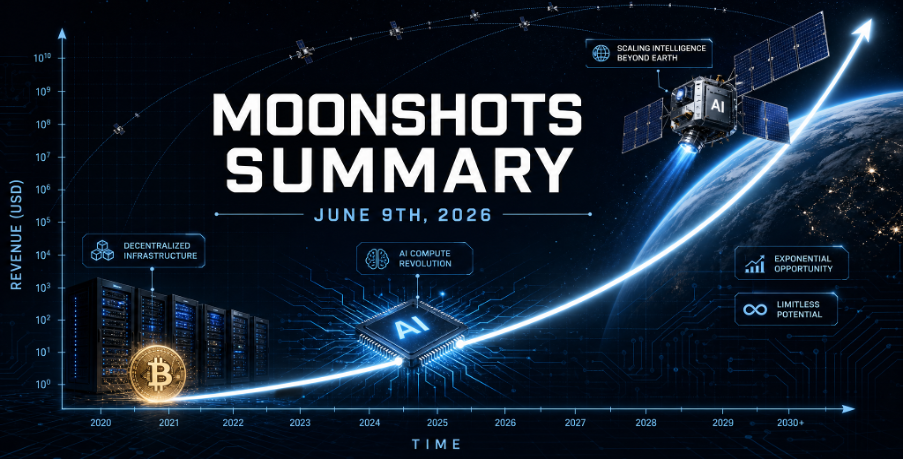
TLDR: The containers we built last century are too small for the decade ahead. Three trillion-dollar IPOs are testing whether there’s enough money in the world to price them. SpaceX is manufacturing the first piece of an orbital compute grid in a Texas field. And in a quieter lab, NewLimit is preparing to put an age-reversal drug into humans next year. Bitcoin is becoming the settlement layer for an economy of machines. Washington is improvising a way to give citizens a stake in companies that may soon dwarf the economy itself. Money, government, and death itself are being rewritten at once.
This week I welcomed a special guest: Brian Armstrong, CEO of Coinbase and co-founder of NewLimit. *Here’s what we covered.*
BITCOIN, QUANTUM, AND THE AGENT ECONOMY
Citibank projected Bitcoin could reach $189,000 by the end of 2026, a number no major bank would have floated five years ago. Brian’s read was measured: it’s never as good or bad as it seems. He thinks Bitcoin bottomed around $60K, sees AI and stablecoins pulling attention away short-term, and remains long Bitcoin as the new digital gold. Salim noted that about 5% of all Bitcoin trades daily versus 0.5% for gold, an accessibility edge that wins over time.
On quantum risk, Brian sees no imminent threat but thinks it’s almost certain someone eventually builds a machine that challenges the cryptography across the whole internet, not just Bitcoin. The chains are already moving: Bitcoin’s BIP-360 proposal, Ethereum roughly 20% through its post-quantum roadmap, and a Coinbase advisory council of cryptographers. The open debate is what to do with the early “Satoshi coins,” an estimated 5 to 10% of all Bitcoin sitting in exposed addresses.
The heart of it was the agent economy. AI agents are becoming paying customers, using crypto wallets to autonomously buy services. Brian put current volume at roughly 100 million transactions and around $50 million in value. His strategy is to make Coinbase “the financial account for AI.” Through the Base protocol, an agent can spin up a self-custodial wallet instantly, no KYC, and settle in USDC in under a second for less than a cent.
Stablecoins as the default rail: The legacy system runs on 1980s COBOL mainframes. Brian wouldn’t rebuild on those even if KYC vanished.
On-chain reputation: To fight fraud, he floated a PageRank-style reputation graph, an on-chain FICO score for agents and merchants.
“The AI economy will eventually be bigger than the human economy.” – Brian Armstrong
“Once you can give AI agents the ability to transact, you enable the machine-to-machine economy, which is going to be millions of times bigger than the human-to-human economy.” – Salim Ismail
Brian and Coinbase are giving the “great unbanked” population of AI agents an economic voice!
WASHINGTON WANTS A STAKE IN THE LABS
Trump called a government stake in the AI giants “a beautiful thing” and floated giving pieces to the public. There’s precedent: the government already holds stakes in 20+ private companies, including 10% of Intel and 15% of MP Materials. Separately, Sam Altman met Senator Bernie Sanders, who wants 50% of equity from top AI companies moved into a public fund. Altman called 50% far too much, but the principle is now a live negotiation.
· Dave’s warning: These moves may fit the AI race with China, but a precedent that the federal government picks private-sector winners is “exactly what Eisenhower warned us against.” What happens when a future administration you dislike inherits that power?
· Brian’s view: Brian was skeptical, asking “Who manages the portfolio, and who decides when to sell?”
“The government has infinite power of taxation. It doesn’t need to own equity to extract any amount of money it wants. Owning equity only inhibits progress.”
– Dave Blundin
Salim framed the deeper problem: these labs are becoming civilization-scale infrastructure, like electricity, and no governance structure exists for a technology that touches every job, industry, and government service at once.
THE TRILLION-DOLLAR IPO PILE-UP
OpenAI filed its S-1 to go public later this year, the third trillion-dollar IPO behind Anthropic and SpaceX. CFO Sarah Friar reportedly worried in April about the company going public, given roughly $600 billion in compute contracts. Alex argued OpenAI rebuilt itself since then: leaning into Codex for revenue, cutting side projects, and switching Stargate from ownership to leasing to de-risk from GPU price swings. Dave’s concern is liquidity: three back-to-back IPOs, each roughly 10x larger than anything in history. Is there even enough money in the world to absorb them?
“The demand for intelligence is almost infinite. But the cost is going to fall way more than Moore’s Law.” – Brian Armstrong
Brian doesn’t think the AI tooling layer holds the durable value. He expects 80% of workloads within 12 to 18 months to run on models that are 99% cheaper for the same intelligence.
SPACEX BECOMES A HYPERSCALER
Google, with its own TPUs, is paying SpaceX roughly $11 billion a year through 2029 to access 110,000 NVIDIA GPUs inside xAI’s data centers. One deal took the SpaceX IPO from 100x revenue to 50x. Salim couldn’t quite believe Google needed external compute at this scale. Dave’s answer: everything is sold out. Alex’s read is that Elon has put Grok on de facto life support to play a longer game, become the biggest hyperscaler first, then buy his way back to the frontier.
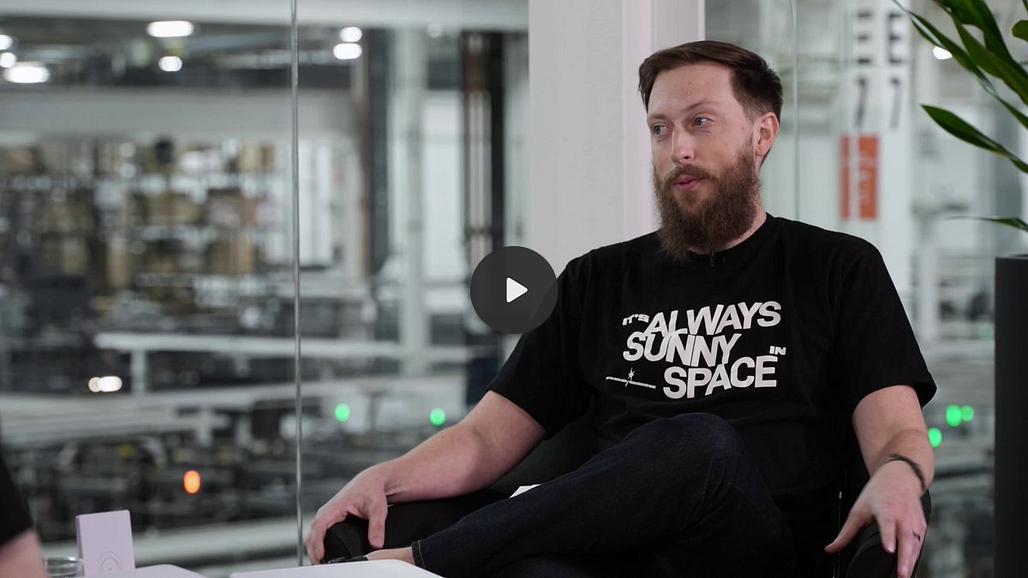
Then SpaceX unveiled AI1, its first AI satellite built for compute in space: 150 kilowatts of peak compute, a 70-meter wingspan, 110 square meters of deployable liquid radiators. Elon says it’s simpler than a Starlink satellite, mostly solar cells and laser links. To build them, SpaceX announced a Gigasat factory in Bastrop, Texas: 1,000+ acres, 11 million square feet, fully integrated from solar ingots to finished satellites. Alex flagged the reason: SpaceX has shown concept videos of mass-driver launches off the Moon. Vertical integration of solar and compute is what lets you eventually manufacture these on the lunar surface.
“AI infrastructure just stopped being a real estate problem and became a launch problem. SpaceX isn’t a rocket company anymore. It’s a civilizational infrastructure company.” – Salim Ismail
Morgan Stanley projects SpaceX revenue could grow from $18.7 billion in 2025 to $3.4 trillion by 2040, valuing the company at $50 to $100 trillion.
My caution: “This is a fundraising tool ahead of the IPO, and Morgan Stanley profits from the deal. I believe in SpaceX long term, but I hope retail investors don’t get hurt in the frenzy.” – Peter Diamandis
LONGEVITY: BRIAN’S OTHER MOONSHOT
Beyond Coinbase, Brian co-founded NewLimit with CEO Jacob Kimmel and Blake Byers, and it just raised $435 million for age reversal. The idea traces to the Coinbase IPO: in 2021, Brian started hosting dinners asking top scientists what was exciting but underfunded. The answer was epigenetic reprogramming, built on Shinya Yamanaka’s Nobel-winning 2012 discovery that four proteins can turn an old cell young.
NewLimit aims to do half of what Yamanaka did: change a cell’s age without changing its type. AI explores the roughly 10 quadrillion protein combinations, then pooled screens, then functional assays (does a reprogrammed liver cell process alcohol like a young one?), then trials. Brian thought this was a 5-to-10-year effort. Instead, NewLimit has reprogrammed human cells and has its first drug candidate entering the clinic next year. I hold Ray Kurzweil’s 2033 target for Longevity Escape Velocity; Alex argued LEV may be “spiky” like AGI, with early GLP-1 signals suggesting a subpopulation could pass it before we notice.
“The baby that’s going to live to a thousand years old is already alive.” – Salim Ismail
Catch the full episode wherever you get your podcasts, and join us at the Moonshots Gathering in Los Angeles. Go to www.moonshots.com to register.
See you next time,
Peter
This Episode’s Moonshots Links
BTC Outlook
“Bitcoin is going to do great and is as important as ever” - Coinbase CEO– x.com/bitcoinarchive/status/2063346015541801285
x.com/trendingbitcoin/status/2063139573522420131 – $2 TRILLION BANKING GIANT CITI BANK JUST SAID BITCOIN IS STILL GOING TO $189,000 IN 2026

Government Stakes in AI Labs
Trump: US Exploring Government Ownership Stakes in AI Companies (Bloomberg / Axios)
Trump surprised tech CEOs by pushing US government ownership stakes in major AI labs. David Sacks called it “corporate-government fusion.” AI exec meeting expected this week.
Trump and Altman Discuss Government Stake in OpenAI (CNBC)
Trump and Altman directly discussed the possibility of a US government stake in OpenAI.
Altman Meets with Bernie Sanders on 50% AI Equity Transfer to Public Fund (WSJ)
Altman met with Sen. Sanders, who plans legislation to transfer 50% of equity from top AI companies to a public fund. US officials are actively discussing financial stakes in the AI industry.
Trump: US Stake in AI Labs ‘Could Be a Beautiful Thing’ (Axios)
Axios confirms Trump surprised tech CEOs by pushing US ownership stakes. Sacks called it “corporate-government fusion.”
x.com/bulltheoryio/status/2063284145959108843 – BREAKING: President Trump wants to give every American a piece of OpenAI, Anthropic, and xAI.
SpaceX
https://techcrunch.com/2026/06/05/google-will-pay-spacex-920m-per-month-for-compute/ – Google pays SpaceX $920M/month for GPU access — SEC-filed deal: $920M/month Oct 2026–Jun 2029 for ~110,000 NVIDIA GPUs at xAI data centers. $11B/year. Compute is the new oil.
x.com/austin_rief/status/2063021559216787871 – It’s crazy that with 1 deal the SpaceX IPO went from 100x revenue to 50x revenue.
Morgan Stanley: SpaceX Revenue Could Reach $3.4 Trillion by 2040 (WSJ) – Morgan Stanley projects SpaceX revenue reaching $3.4 trillion by 2040. A staggering long-term projection as the company nears IPO.
S&P 500 Blocks Fast SpaceX Entry; Won’t Waive Rule for Unprofitable AI Firms (Ars Technica) – S&P 500 won’t waive profitability rule for SpaceX or other unprofitable AI firms, blocking fast index entry despite NASDAQ accommodations.
SpaceX Gigasat Factory:


Hyperscalers & Chips
Hyperscalers to Spend $600B+ on Data Centers in 2026 (Business Insider) - $600B+ funneled into data center buildout in 2026 alone by big tech.
Apollo + Blackstone Finalize $35B Anthropic Chip Deal — Largest Private AI Infrastructure Financing (Business Review Live)
Largest private AI infrastructure financing in history. Funds buy Google TPUs for Anthropic. Broadcom backstops the largest portion.
Siri & Google: https://www.apple.com/newsroom/2026/06/apple-unveils-next-generation-of-apple-intelligence-siri-ai-and-more/
Biotech & Longevity
Aging is arguably the root cause of most major diseases (loss of function in our cells). Four years ago, we made a bet that aging was treatable, and NewLimit was born. - Brian Armstrong – x.com/brian_armstrong/status/2061853377483493421
CRISPR Gene Editing of Human Embryos (NYT) – New developments in CRISPR gene editing of human embryos. (NYT investigation.)
World’s Oldest Woman’s DNA Decoded — Biological Markers Decades Younger (EcoPortal) – Scientists found her biological markers decades younger than her chronological age. Key longevity factors identified in genome and daily diet.
More From Peter
If you’ve enjoyed Metatrends, here are more ways to stay connected:


Who is monitoring Elon’s health? It’s that important and if he can’t get to Fountain Labs….can the best do FL come to him?
Maybe I’m missing something, but doesn’t economy have to go 10 X when people actually buy things? What’s driving net story other than some transaction efficiency?