New Data: Colleges in Trouble
Metatrend #1: Abundance: Food, Energy & Education

“Go to college, get a great job” is no longer the valid paradigm. And this is putting higher education in a tailspin.
Here’s the data you should know:
Americans calling college “very important” crashed from 75% to 35% in 15 years, while “not too important” quintupled to 24%
Tuition is up 899% since 1983, saddling 42 million borrowers with $1.8 trillion in debt—second only to mortgages
College graduates now make up one-third of the long-term unemployed, up from one-fifth a decade ago
Job postings requiring degrees dropped 6% since 2019
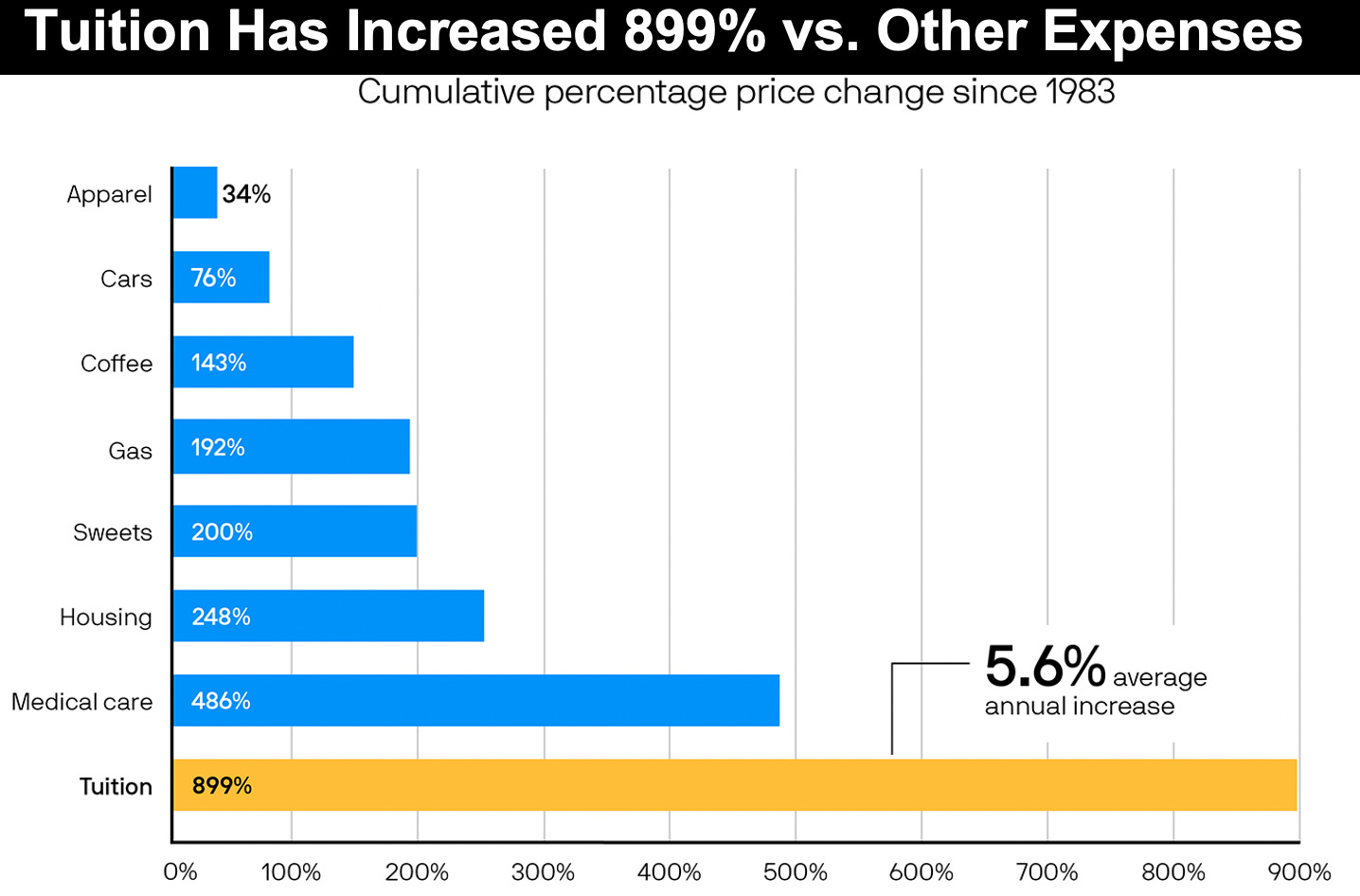
You’re paying a quarter million dollars for a private university education that increasingly guarantees nothing. The credential that used to open doors is now locking people out.
So, what do you (or your kids) do about it?
1/ You need to credential yourself differently now. College used to be the way to signal competence. That era is over. Today, credentialing means building a portfolio that demonstrates value: GitHub repositories showing what you’ve shipped, a consulting practice proving you solve real problems, a YouTube channel teaching what you know. The act of getting accepted by MIT still matters. The four years spent there increasingly don’t.
2/ Top ten schools remain exceptions (and still surprisingly credible). If you’re getting into MIT, Harvard, Stanford, or their peers, the brand still carries weight. These institutions run on massive endowments: their investment returns contribute over twice as much to their budgets as all tuition combined. But schools ranked 40 to 400? They’re facing an existential crisis as perceived value craters.
3/ Employers are waking up to degrees being worthless. Companies are hiring without degree requirements at accelerating rates. Why? Because the curriculum moves too slowly. As one MIT administrator admitted: “We can build a nuclear reactor on campus faster than we can change this curriculum.” By the time you graduate, what you learned freshman year is obsolete.
4/ Master one skill: growing revenue, and you’ll always have work. Most companies care about exactly one thing: increasing revenue. If you can demonstrably grow top-line numbers, degrees become irrelevant. Show me you drove $2M in new sales or built a product that acquired 100K users. That’s infinitely more valuable than a transcript.
5/ The best educator in the world will be AI-driven. AI tutors will provide one-on-one adaptive instruction in any subject, any language, at near-zero cost. Programs using AI-assisted learning already show students learning 5-10 times faster than traditional classrooms. The university model of one professor lecturing 300 students is dead… it just doesn’t know it yet.
6/ Trade school is now another option. As Jensen Huang, CEO of Nvidia, recently said: “If you’re an electrician, you’re a plumber, a carpenter—we’re going to need hundreds of thousands of them to build all of these factories.” These professions today command immediate jobs and salaries between $100,000 and $150,000 per year without the extraordinary debt of college.
Here’s the opportunity: The credential economy is being rebuilt from scratch. The old gatekeepers are losing their monopoly. This creates a massive opening for those who demonstrate value directly through their work product, build networks through entrepreneurship, and learn faster using AI than any traditional program could teach.
The future belongs to the self-credentialed.
Until next time,
Peter
PS—Worth Your Attention
If you’re building something that matters and want to leverage exponential technologies like AI to do it — Abundance360 might be for you.
Enrollment is open.
There is a group organizing community dinners for Moonshot podcast listeners in Los Angeles. If you are in LA and want to spend some time with fellow listeners, you can sign up here: moonshotdinners.com.
More From Peter
If you’ve enjoyed Metatrends, here are more ways to stay connected:


Hi Peter, please tell me your opinion on the state of the economy of the CCP and China mainland as a whole? Is it still surviving or is it on the brink of collapse as many have prognosticated?
That statistic about Americans calling college 'very important' crashing from 75% to 35% is truly alarming for the traditional model.
I wonder if for many, the social capital and networking component is now outweighing the purely educational value proposition. If that's the case, the crisis might not just be about curriculum, but about redefining what "college" truly means in the digital age.
Perhaps the future successful model will be a hybrid: focused, skills-based credentialing combined with curated, high-impact social/networking experiences.