

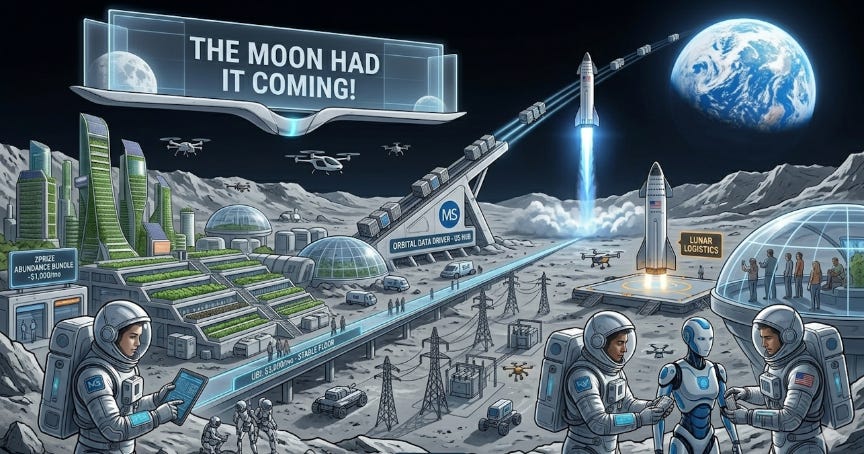
When I was a kid, the Apollo Program and Star Trek lit my soul on fire. I was hoping by the year 2000 we’d have colonies on the Moon and Mars. But that never happened. A risk-adverse NASA with lack of congressional funding, pulled back on that vision… until now.
“We are about to speed-run Star Trek. This next decade will be remembered as the moment in time that humanity irreversibly moved off the Earth into the cosmos. The last time something like that happened was when the lungfish moved out of the oceans onto land.”
A few stories broke over past week that most people are reading as separate headlines. I’m reading them as chapters in the same book, and that book is the opening act of off-world civilization.
NASA pivoting the Artemis program from Boeing (SLS) to SpaceX (Starship). China committing to landing on the Moon by 2030. Elon plans to build a Dyson Swarm of datacenter satellites with materials from the Moon. Potatoes growing in lunar soil.
These aren’t random space news. These are the proof points that we’ve crossed from speculation to execution. And the timeline is shorter than you think.
Let me walk you through what happened, why it matters, and what you need to do about it.
SpaceX v. Boeing – NASA Chooses Starship
Here’s the first story, and it’s massive: NASA’s new administrator—Jared Isaacman, an incredible individual I’m proud to call a friend—is elevating Starship (SpaceX) into the Artemis program (America’s new lunar efforts), scaling back the role of SLS significantly.
Starship will now be propelling astronauts to the Moon. Not as a backup. Not as a secondary option. As the primary vehicle.
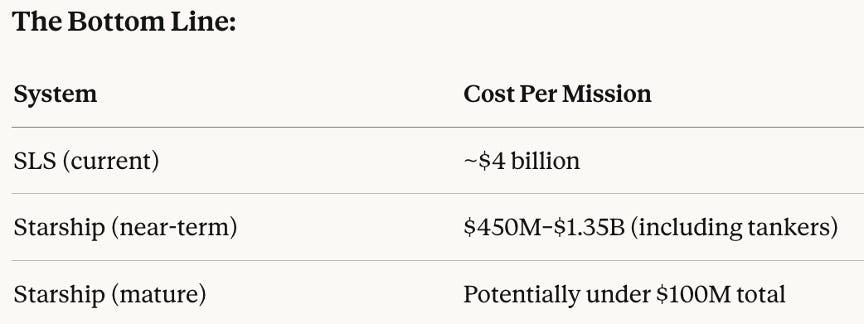
The Trump administration’s FY2026 budget proposal described SLS as “grossly expensive,” noting it costs $4 billion per launch and has exceeded its budget by 140%. NASA’s current budget proposed terminating SLS and Orion after Artemis III.
How much will Starship cost for a similar mission? For a lunar mission specifically, a single Starship launch isn’t the full picture — SpaceX’s lunar architecture requires multiple Starship launches to refuel the vehicle in orbit before it can head to the Moon. Current estimates suggest 4 to 14 tanker flights plus the crewed vehicle itself. So, a full Starship lunar mission system might involve 5-15 launches. Even at $90 million per launch, that’s $450 million to $1.35 billion total: still 3 to 9 times cheaper than a single SLS mission.
“Designed to be fully reusable, Starship aims to bring launch costs down to $2 million to $10 million per launch at full operational maturity, which would eventually drop future Starship Lunar missions to $100 million. That’s 40x cheaper than Boeing’s SLS mission.”
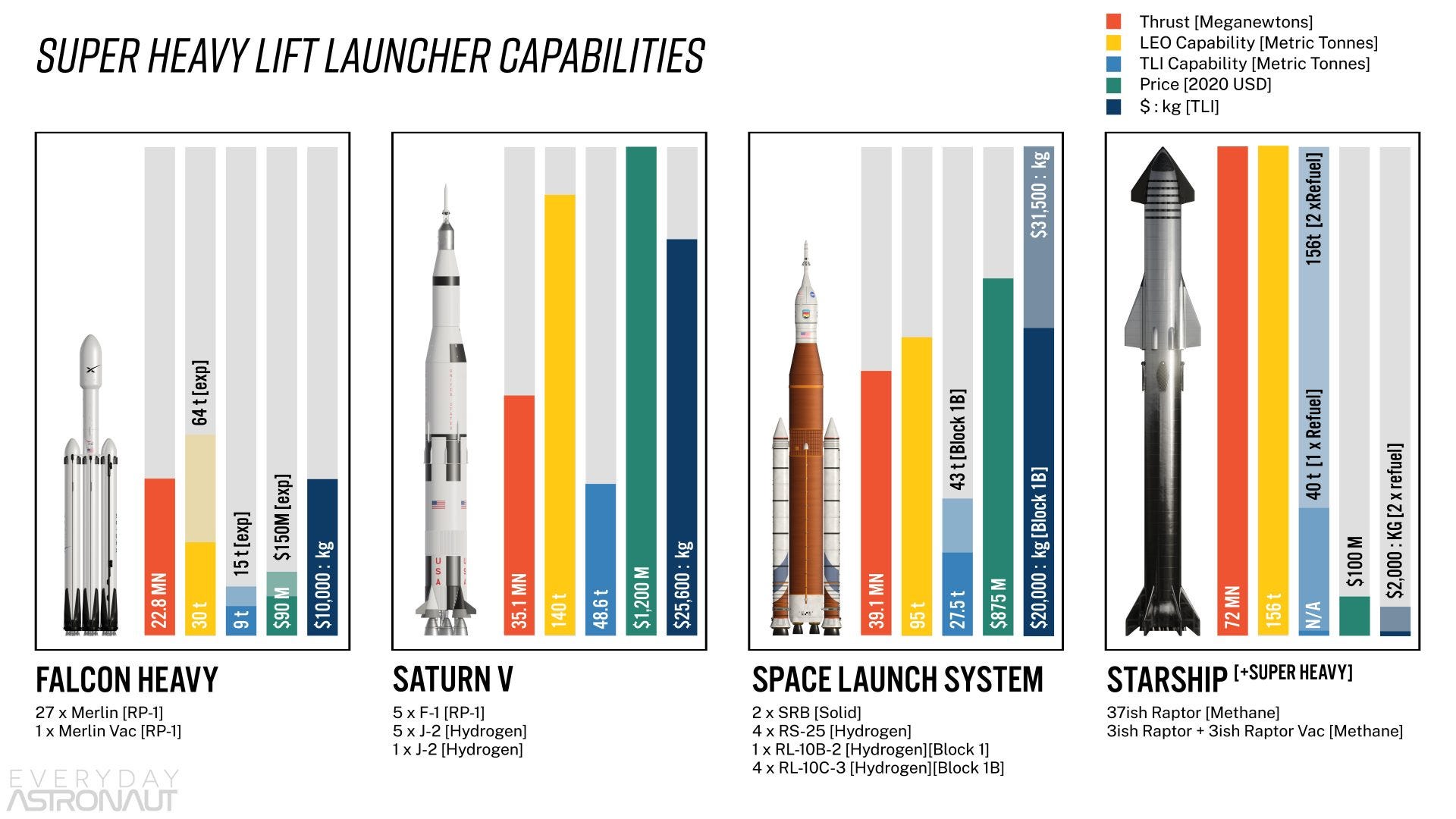
I honestly don’t know why the SLS has existed as long as it has. Starship is going to do a clean sweep of this. And I think Blue Origin will be in the mix too.
But here’s the bigger point: This is the permanent shift from government-led to commercially-led space exploration. NASA isn’t building the rockets anymore. NASA is the customer. SpaceX is building the infrastructure.
And that changes everything.
Back to the Moon after 54 Years!
Regardless of the economics, we are FINALLY, heading back to the Moon.
The Boeing-lead SLS/Orion spacecraft will carry 4 astronauts on an Apollo 8-style circumlunar orbit. Following a successful “readiness review” which happened March 12th, Artemis II is scheduled to launch as early as April 1st.
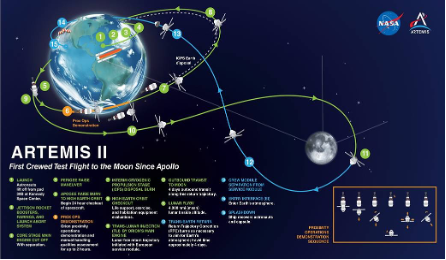
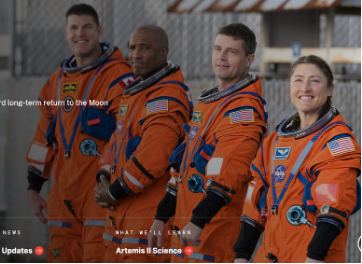
Four astronauts will fly on Artemis II: Commander Reid Wiseman, pilot Victor Glover, and mission specialist Christina Koch from NASA, and mission specialist Jeremy Hansen from the Canadian Space Agency.
US vs. China: Race to the Moon
This is not just about SpaceX vs. Boeing. It is the starting gun for the first Moon race since 1972. While Artemis II is lifting off soon on its flyby mission, the real competition will be for boots on the lunar surface. NASA now targets early 2028 for Artemis IV’s first crewed lunar landing, using SpaceX’s Starship as the Human Landing System. But China recently made the stakes crystal clear: in October 2025, the China Manned Space Agency reaffirmed its “fixed goal” to land astronauts on the Moon by 2030, with all hardware development “progressing smoothly.”
“While the U.S. has a two-year head start on paper, China’s timeline for a human landing by 2030 is firm and publicly committed. This is the Apollo vs. Soviet Union style space race of the 1960s.”
Whoever wins the Moon unlocks helium-3 energy, orbital compute infrastructure, and the economic foundation for Mars. The race isn’t to plant a flag… It’s to own the infrastructure that makes everything else possible.
Building Industries & Growing Food on the Moon Means a Growing Lunar Economy & Civilization
Here’s the next story: researchers just proved that potatoes can grow in lunar soil.
Recent work used lunar regolith simulants (e.g., LMS‑1E), made from crushed terrestrial rocks and volcanic ash matched to lunar chemistry and grain size. In these experiments, potatoes did grow, but in “pure” simulant they were smaller and yields were significantly reduced compared with normal potting soil.
Adding organic material (e.g., as little as 5% in some setups) greatly improved plant size and tuber yield, bringing them close to control-soil performance.
Elon’s Crazy Vision in 3-Phases: Beyond potatoes, let’s talk about a massive industrial footprint for building and launch massive datacenters into space. This is Elon’s “Out-of-this-World” vision for compute, which he laid out in three phases:
PHASE 1: The Orbital Satellite Architecture
In Musk’s own words on X: “1 megaton/year of satellites with 100kW per satellite yields 100GW of AI added per year with no operating or maintenance cost, connecting via high-bandwidth lasers to the Starlink constellation.” Musk’s next goal is a terawatt of compute in orbit.
Now let’s talk about what it takes to actually build a terawatt of orbital compute.
Elon laid out the math during his Terafab announcement: to get one terawatt of compute per year into orbit, you need approximately 10 million tons of mass to orbit annually, at 100 kilowatts per ton.
“At Starship’s current payload capacity of roughly 100 tons per launch (accounting for refueling architecture), that means 274 Starship launches per day: one every 5.3 minutes, 24/7/365.”
For context, the entire global space industry launched about 200 times total in 2023. SpaceX is targeting more launches per day than the world achieved in a year just three years ago. This is much more than an incremental improvement in launch cadence. This is industrial-scale access to space: the kind of throughput that turns orbital infrastructure from a science project into a supply chain.
PHASE 2: Lunar Manufacturing and the Mass Driver
This is where it escalates dramatically. Musk has stated: “The level beyond that is constructing satellite factories on the Moon and using a mass driver—electromagnetic railgun—to accelerate AI satellites to lunar escape velocity without the need for rockets. That scales to more than 100TW/year of AI.”
The proposed lunar facility would utilize a mass driver (a massive electromagnetic catapult system) to launch finished satellites into orbit, leveraging the Moon’s lower gravity and lack of atmosphere to deploy heavy payloads more efficiently than traditional rocket launches from Earth.
A lunar electromagnetic mass driver could slash payload launch costs from $1,200 per pound to just dollars per pound in electricity, potentially the single biggest reduction in the cost of intelligence in human history.
PHASE 3: The Dyson Swarm / Petawatt Scale
Musk concluded his Terafab presentation with a video showing future data center satellites being built on the Moon and launched using the electromagnetic mass driver. Those satellites, he said, would be needed to place a petawatt (1,000 terawatts) of computing in space.
My Moonshot mate Alex Wissner-Gross did the math on what it would take to build a petawatt of compute from lunar mining.
His answer was: about three one-hundred-thousandths (3/100,000ths) of the lunar mass.
AWG continued on his plans for lunar disassembly when he said: “As we scale to an exawatt of compute—and because why not—then at that point, we’re talking something like 3% of the Moon’s mass.”
“When people think I’m joking when I talk about disassembling the Moon or the Moon had it coming, this is what it looks like. The Moon is slated for rapid scheduled disassembly to build humanity’s first Dyson swarm.’
So let me connect the dots: Food from lunar soil. Compute from lunar mining. Starship launching one every 5.3 minutes.
That’s an engineering roadmap.
What It Means When Everything Converges…
Here’s what I see when I connect all the stories above:
NASA pivoting to SpaceX means the infrastructure for getting to the Moon is now commercially viable and economically sustainable.
Food growing in lunar soil means we can sustain human presence off-world.
And the Terafab—with its one-terawatt goal and eventual petawatt from lunar mining—means we’re building the computational infrastructure to support an off-world economy.
We’re no longer speculating about off-world civilization... we are pricing it.
“I’ve said this before, but I believe the Musk ecosystem—Tesla, xAI, SpaceX, the Terafab—will lap by an order or two of magnitude what Nvidia has done. It may become the largest, most important company on and off the planet. In fact it may be the first $100 trillion company (corporate conglomerate) of our lifetime.”
When you’re generating 50 times the total output of AI chips on the planet, when you’re launching every 5.3 minutes, when you’re building orbital data centers and lunar settlements, you’re not in the tens of billions category. You’re in the tens of trillions.
What You Need to Do
Okay, so off-world civilization just went from science fiction to engineering problem.
What do YOU do about it?
If you’re an entrepreneur: Start thinking about the space supply chain. What does a permanent lunar settlement need? Not rockets… SpaceX has that covered. Think life support, food production, habitat construction, mining equipment, power generation, communications infrastructure. The bottlenecks are all the things that come after transportation. That’s where the opportunities are.
If you’re an investor: Pay attention to the Musk ecosystem unification thesis. This Terafab is sufficiently crucial (with 20% of production slated for Tesla and 80% for SpaceX) that it starts to look like a cornerstone for some grand unification of all of Elon’s projects.
SpaceX IPO prediction markets are already pricing this in. Originally one and a half trillion. Now over two trillion, pricing in the SpaceX portion of the Terafab.
If Elon unifies the capital raising with a massive multi-trillion-dollar IPO, you’re looking at the ultimate leverage play. That’s what it’s going to take to build these fabs in parallel at this scale.
For everyone: Here’s my final thought…
For billions of years, it’s just been sitting there. No atmosphere. No life. No purpose beyond tugging on our tides and inspiring poets.
Now it’s about to become the foundation for off-world civilization. Its soil will grow our food. Its mass will build our compute. Its orbit will be our highway.
And when we look back from Mars, from Europa, from the Kuiper Belt, we’ll remember this week as the moment when the engineering began.
The Singularity is not waiting. And neither is the cosmos.
- Peter
More From Peter
If you’ve enjoyed Metatrends, here are more ways to stay connected:


I watched the first Moon landing on a black and white Zenith, my dad gathering the whole family in front of it like it was church. That moment felt like the ceiling of what was possible. Now launches happen on a Tuesday and nobody looks up. The fact that we went from that Zenith to "one Starship every 5.3 minutes" in a single lifetime is the story most people are too close to appreciate. Elon catches hell from every direction, and visionaries always do...the peanut gallery is loudest when someone's building something they can't imagine. The data here speaks for itself. Know your SUMs. This is the great wild west of our time, and the engineering roadmap you've laid out reads like the journal entries we'll wish we'd paid closer attention to. Glad to be alive for this chapter.
I just love it. Although the anti-capitalist resenters will be jumping up and down about some implications of this, we just can't out-perform that combination of the free markets with genius, vision, imagination and courage, it's just completely wonderful. And remember that whatever this does to Mr Musk's personal wealth, there will be masses of employment and business opportunities in here, for an endless supply of people, and no, it won't all "disappear" into AI. LLMs don't care about vision and exploration and the future. Humans do! Humans have the motives!