


Elon described the near future as a “supersonic tsunami”: a wave moving so fast and so large that by the time you hear it coming, it has already broken over you. The phrase stuck with me. So let me lay it out in detail, with the actual numbers, because I don’t think most people have any real sense of what the next 60 months hold.
Buckle up.
GENIUS FOR LESS THAN A CUP OF COFFEE
Start with the price of intelligence, because it is collapsing faster than anything in the history of technology. According to the Stanford AI Index, the cost of tokens dropped 280x collapse in 24 months. For frontier models, the price has been dropping about 10x every single year, from $20 to about $0.40 per million tokens. Not 10% cheaper. Ten times cheaper, annually.
“We are past the event horizon; the takeoff has started. Humanity is close to building digital superintelligence.”
— Sam Altman, OpenAI
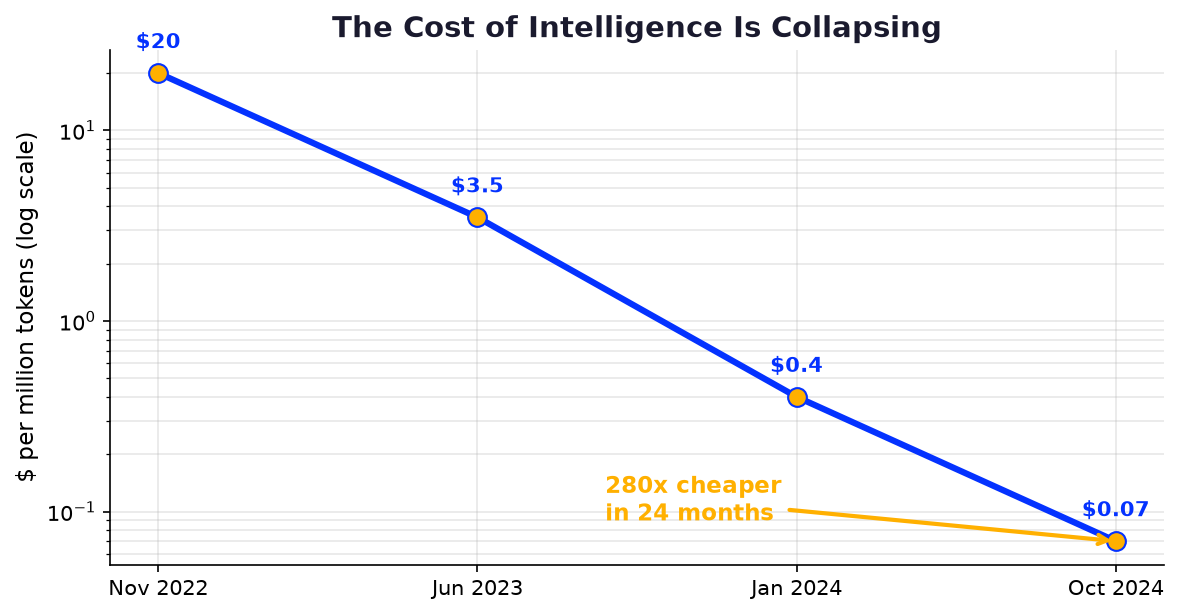
Source: Stanford AI Index 2025 (GPT-3.5-level inference, $/million tokens).
Now stack that against the AGI race itself. Dario Amodei has said a system amounting to “a country of geniuses in a datacenter” could come online as early as late 2026 to 2027. Elon predicts AGI before the end of this year. Whatever month it lands, the meaningful event is recursive self-improvement: AI that designs better AI, on a loop, with each turn faster than the last.
Soon thereafter comes artificial superintelligence (ASI): a single system more capable than the combined intellectual output of all of humanity, across every domain at once. Elon told me he expects “digital intelligence to exceed the sum of all human intelligence by around 2031.” One mind, smarter than eight billion of us put together, available for pennies.
The implication is brutal and beautiful at once: every knowledge job built on “I know something you don’t” gets repriced overnight, while every founder, researcher, and dreamer suddenly commands a research staff of a thousand PhDs for the price of lunch. The moat stops being what you know and becomes what you choose to point that intelligence at.
“It blows my mind multiple times a week. Just when I think ‘wow,’ two days later, more wow. Exponential wow.”
— Elon Musk, on the Moonshots podcast
THEN AI SOLVES EVERYTHING…
Point that intelligence at the hardest open problems we have: math, physics, chemistry and biology. As my Moonshot Mate Alex Wissner-Gross says, “we are about to speed-run every science fiction movie and solve-everything.” AI already proves theorems, predicts the structure of 200 million proteins, and designs novel molecules from scratch. Now run it 1,000x faster and 280x cheaper.
We are about to compress centuries of discovery into a handful of years: room-temperature superconductors, new battery chemistries, materials that don’t exist in nature, drugs designed atom-by-atom for a single patient’s tumor. Every one of those breakthroughs creates wealth. It saves a life, extends a life, or quietly turns last year’s miracle into this year’s Tuesday. The discoveries will arrive faster than any of us can read the headlines announcing them.
“After powerful AI, we will make all the progress in biology and medicine in a few years that we would have made in the whole 21st century.”
— Dario Amodei, Anthropic (“Machines of Loving Grace”)
Here’s the implication: the bottleneck on progress flips. For all of human history, the scarce resource was brainpower (i.e., enough brilliant minds, enough time, to chase down a hypothesis). When that becomes infinite and nearly free, the constraint moves to the physical world: how fast can we run the experiments, build the reactors, fabricate the chips. Atoms become the bottleneck, not ideas. The winners of the next decade will be the people who can move atoms as fast as AI moves bits.
HOLLYWOOD IN YOUR POCKET, AND A CONVERSATION WITH ANYONE
Within the next two years you’ll stream a full feature film generated on demand (your mood, your cast, your language) for the cost of a search query. The marginal cost of a blockbuster falls toward zero.
Stranger still, you’ll sit down with anyone. Einstein to walk your daughter through relativity. Marcus Aurelius for a 2 a.m. talk on how to live. A living celebrity rendered so faithfully you forget it’s software. The line between a real person and a digital persona blurs to the point that “AI personhood” stops being a sci-fi punchline and becomes a question courts and legislatures actually have to answer.
And this reaches past entertainment. A child anywhere on Earth gets a patient, brilliant tutor that costs nothing, the greatest equalizer in the history of education. But you can no longer trust that the face on your screen is real, and “Who owns your likeness after you die?” becomes a live legal fight. Abundance and disruption, on the same wave.
THE ROBOTS ARE COMING HOME: BY THE HUNDREDS OF MILLIONS
Here is where the numbers get truly strange. A Tesla Optimus is targeted to cost $20,000 at scale; Tesla is openly scaling to build one million units a year. 1X’s Neo is priced at $20,000, or $499 a month. Unitree’s G1 already sells for about $13,500. Analysts expect capable consumer humanoids at $10,000–$20,000 by 2030.
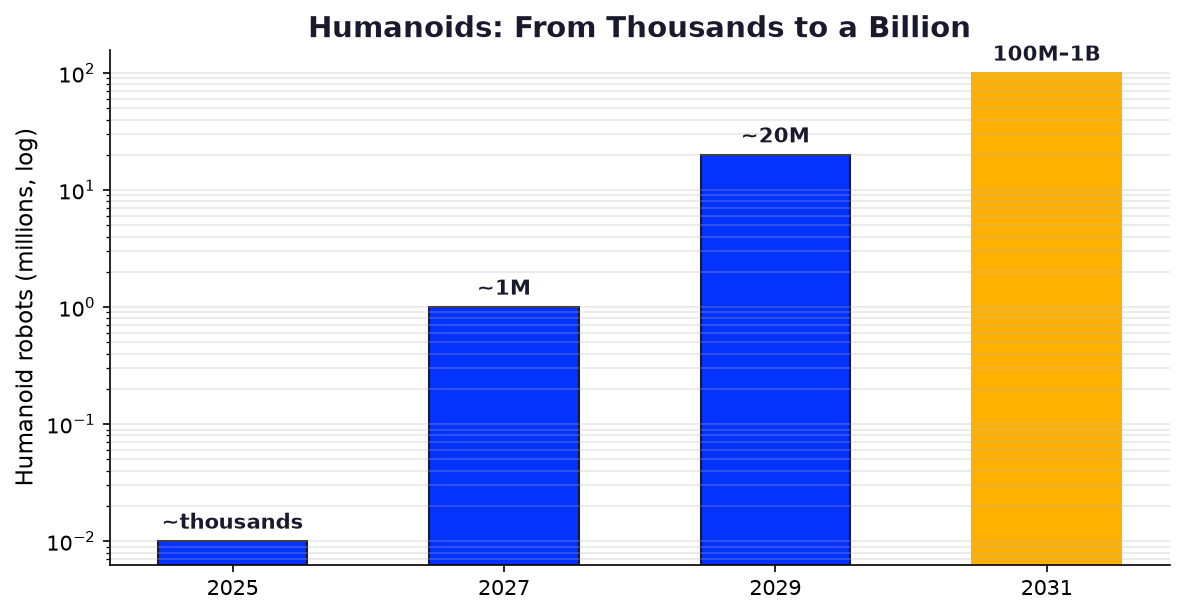
Source: Elon Musk projection (100M–1B humanoids by 2031); illustrative ramp.
Financed over five years, a $20K robot runs roughly $300 per month… $30 per day, well under a dollar an hour for a machine that never sleeps. Elon’s projection: 100 million to 1 billion humanoid robots by 2031. The intelligence inside them is the same frontier model collapsing in price above, so your robot won’t just fold laundry. It will cook like a Michelin chef working from ten thousand recipes, conduct a surgery with sub-millimeter precision, tutor your kids, and care for your aging parents with patience no exhausted human can sustain at 3 a.m.
“In three years, at scale, there will be more Optimus robots that are great surgeons than there are surgeons on Earth.”
— Elon Musk, on the Moonshots podcast
The result is the biggest labor shift since the tractor emptied the farms. Physical work, the thing that has defined the human economy since we stood upright, starts trending toward free, toppling the cost of building, manufacturing, and caregiving. The same robots that displace a task give a billion people their hours back. The hard question every society now has to answer: when work is optional, where do meaning and dignity come from?
YOUR BODY BECOMES EDITABLE CODE
This is the part I care about most. Biology is becoming readable, then writable, something we debug, patch, and rewrite. Disease stops being fate and becomes an engineering problem. Aging itself moves onto the list of things we can slow, halt, and one day reverse.
I watch the early version of this every day at Fountain Life, the company I co-founded to catch disease before it catches you. Roughly two of every ten members walk in feeling perfectly healthy and walk out with a life-saving diagnosis: a stage-1 cancer, an aneurysm quietly waiting to kill them. That’s today’s technology, before AGI. Add five years of superintelligence on top and “your healthspan” (the single most valuable asset you own) gets the upgrade of the century.
“I think we can cure all disease with the help of AI. The end of disease is within reach, maybe within the next decade.”
— Demis Hassabis, Google DeepMind / Isomorphic Labs
The outcome is the one I care about most: longevity escape velocity (LEV) moves from a slide in my keynote to a planning assumption for your life. If we can add more than a year of healthy life for every year you stay alive, then your single most important job right now is simply to not die of something stupid in the interim. To make it to the next breakthrough, and the one after that. My mentor and friend Ray Kurzweil predicts we will reach LEV by 2033. Health stops being the thing you spend wealth on and becomes the foundation that lets you enjoy all the rest.
“A doubling of the human lifespan is not at all crazy, and with AI we may be able to get there in five to ten years.”
— Dario Amodei, Anthropic
THE SKY AND THE STREETS, REINVENTED: AT 20 CENTS A MILE
Look out the window. A human rideshare today costs you roughly $2.00 a mile. Cathie Wood, ARK Invest, projects a Waymo will run about 40 cents a mile by 2030, and Tesla’s purpose-built Cybercab closer to 20 cents. A 10x cut that makes owning a depreciating car parked 95% of the day look absurd.
Above the gridlock, eVTOLs (flying cars, finally real) are crossing from prototype to certified product, turning the empty sky over our cities into open highway. Drones drop our packages, inspect our bridges, and rewire global logistics. Cheap, ubiquitous, autonomous movement on the ground and in the air will rebuilds where we live, how far we’ll commute, and what a city even is.
The implication ripples straight into the largest asset class on Earth: real estate. When a 60-mile commute costs a few dollars and you can read, sleep, or work the whole way, the premium on living near the office evaporates. Land 90 minutes out becomes 20 minutes up. The parking lots and garages that swallow a third of every city center are freed to become parks. We will quietly redraw the map of where humans choose to live.
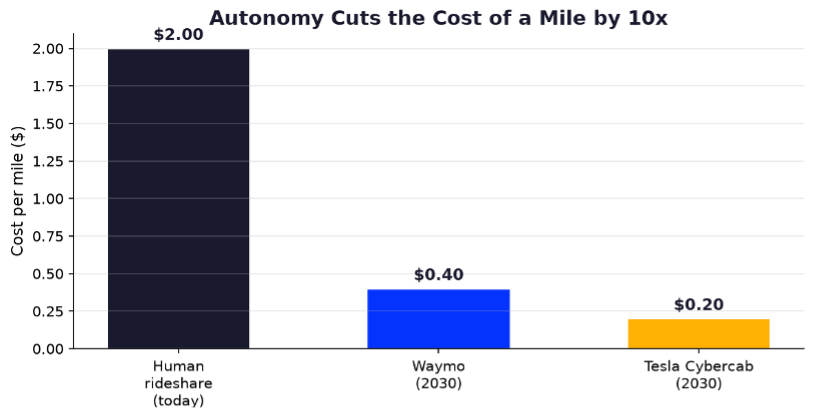
Source: ARK Invest cost-per-mile projections, 2030 (via Top 10 Metatrends Report).
THE ECONOMY GOES VERTICAL
Now for the number that stops people in their tracks. When I interviewed Elon on the Moonshots podcast, he told me he expects something on the order of a 10x expansion of global GDP within ten years: a world economy climbing past a quadrillion dollars, with the doubling period collapsing from decades to a handful of years.
I’ve known Elon for 26 years. I’ve watched smart people bet against his vision for two decades. They keep losing. So when he throws out a number like that, I don’t laugh. I run the math, and I hand it to the young founders I mentor: if global GDP is heading toward $1.2 quadrillion and only a small handful of people are doing genuinely foundational work, your personal quota (the value you’d need to create just to keep pace) lands near $10 billion. Watching that number register on a 25-year-old’s face in Dave Blundin’s Link Studios is one of my favorite things in the world.
“In the next 18 months we hit 10% GDP growth, and by 2030, triple-digit: 100% GDP growth.”
— Elon Musk, on the Moonshots podcast
This is the engine under everything else: free intelligence, plus tireless robots, plus discovery on fast-forward. This does more than merely improve life. It manufactures wealth at a scale the species has never seen, with no natural ceiling in sight. The hard part was never creating the Abundance. It’s deciding how widely we share it.
“If AI becomes advanced enough to run companies, why not my own? I should be the most willing to do that.”
— Sam Altman, OpenAI
The upshot is the defining political and moral question of the next decade. A quadrillion-dollar economy can lift everyone or concentrate in a few hands. The technology is indifferent… the choice is ours. I’m betting on broad Abundance, because for the first time the size of the pie is effectively unbounded, and a world of empowered, healthy, optimistic people is simply a better market, a more stable society and a better place to live. But it won’t happen by accident. We have to build it on purpose.
WHAT THIS MEANS FOR YOU
If you’re an entrepreneur: point superintelligence at a trillion-dollar problem, not a feature. Your competitive moat is no longer knowledge. It’s the audacity of the problem you choose and the speed at which you move atoms.
If you’re an executive: assume the cost of cognition and physical labor both trend toward zero inside five years, and rebuild your org chart around that. This is the start of what Salim Ismail calls the “organizational singularity.” The companies that win will retool now, not after their competitors already have.
If you’re an investor: the value is migrating to whoever owns the bottleneck: energy, compute, robots, and the physical capacity to build. Bet on the picks and shovels of a quadrillion-dollar economy.
If you’re a student: stop memorizing what a machine knows better, and master the things it can’t hand you: taste, judgment, the ability to ask the right question and rally humans around an answer. Learn to direct intelligence, not compete with it.
If you’re a parent: your kids will grow up in a world heading towards Star Trek, with a tutor smarter than any professor and a robot in the home. Raise them curious, purpose-driven, adaptable, and kind. And keep them and yourself healthy long enough to ride this wave all the way out.
RIDE THE WAVE
“It’s a supersonic tsunami. You have to surf on top of it, or be crushed by it.”
— Elon Musk
Genius for forty cents. ASI by 2031. A billion robots for under a dollar an hour. Transport at 20 cents a mile. Aging on the list of solvable problems. A quadrillion-dollar economy.
The wave is already here. It’s loud, fast, and not waiting for permission. So I’ll leave you with the only question that matters: are you on the beach watching it come, or out on the board, paddling hard, ready to ride?
To a future of Abundance,
Peter
P.S. How much is an extra decade of healthy life worth to you?
The Abundance Longevity Trip (October 7–11, San Francisco) is five days of access you can’t get anywhere else: private visits to leading research labs, direct conversations with the scientists and biotech founders shaping the longevity revolution, and personalized diagnostics and therapeutics most people don’t know exist.
I personally host and guide 80 Members each year. Investors come for the pre-market deal flow. Researchers and practitioners come for the latest science. Others come for personal health breakthroughs. Everyone leaves with relationships and insights that change how they think about their future.
Secure one of the final 3 seats.
Peter
More From Peter
If you’ve enjoyed Metatrends, here are more ways to stay connected:


A powerful read, Peter.
However, there is a stark disconnect between exponential tech charts and human reality.
For many, life right now feels incredibly heavy and opportunities seem almost nonexistent. When you are just trying to survive the day-to-day, a 'supersonic tsunami' sounds less like an opportunity and more like a threat.
I truly hope this collapse in the cost of intelligence translates into real, tangible open doors for everyday people who desperately need them.
Every prediction in this piece is individually plausible. The part that doesn't get stress-tested is the assumption that they're independent. Cheaper intelligence, a billion robots, longevity breakthroughs, autonomous transport, and scientific discovery on fast-forward all sound like separate trends compounding in parallel. They're not. They share the same dependencies: abundant energy, stable rare earth supply chains, continued semiconductor scaling, functioning global trade, and political stability. A disruption to any one of those doesn't slow one prediction. It slows all of them at once, because they all draw from the same infrastructure.
We've watched three of those dependencies come under stress this year alone. The Strait of Hormuz closed and energy prices spiked. China restricted rare earth exports and the Pentagon paid a 900% premium for scandium. Export controls on advanced chips forced an entire industry to rebuild its supply chain from scratch. The quadrillion-dollar economy requires all of these trends to compound uninterrupted for a decade. Each one can survive a brief disruption. Whether they can all survive the same disruption at the same time, and whether a decade can pass without one, is the question the wave metaphor quietly assumes away. The wave is real. The ocean it's travelling through isn't as calm as the article needs it to be.