

The job apocalypse is not happening. I know that’s not what you’ve heard. Dario Amodei said 50% of entry-level knowledge workers would lose their jobs. Sam Altman echoed similar doom. Bernie Sanders called for an AI slowdown because of jobs. For the past two years, the headlines have all said that AI is coming for your career.
“170 million new roles. 92 million displaced. Net gain: 78 million jobs. The apocalypse is not coming. The transformation is.”
The data says something different. The World Economic Forum projects 170 million new roles created and 92 million displaced by 2030 — a net gain of 78 million jobs. Stanford found that firms adopting AI saw employment grow 10% in the two years following adoption. LinkedIn reports a 69% increase in people adding ‘founder’ to their profiles.
AI displaces tasks, not occupations. It eliminates the boring parts of your job, not your job. And the people who learn to use it are the ones who thrive.
What the Data Shows
Don’t let headlines drive fear or dictate your strategy; instead, let’s look at the data.
Here’s what the actual research says:
The World Economic Forum’s Future of Jobs Report: 170 million new roles created, 92 million displaced by 2030. Do the math — that’s a net gain of 78 million jobs globally.
Stanford SIEPR: among firms that adopted AI, employment grew by 10% in the two years following adoption. Not layoffs. Growth.
LinkedIn’s report: a 69% increase in people adding ‘founder’ to their profiles. Half of US small businesses said AI inspired them to consider entrepreneurship. 57% of small businesses believe AI will improve their daily work lives.
AI-related job postings grew 3.5x between 2023 and 2025, per LinkedIn’s Economic Graph. Cognizant found that 93% of US jobs can be partially performed by AI, unlocking $4.5 trillion in labor productivity. The PwC 2026 AI Jobs Barometer and BCG both concluded that AI is reshaping more jobs than it replaces.
An NBER study surveyed 6,000 executives across four economies — more than half reported that AI was changing their workforce needs. Not eliminating workers. Changing what they need workers to do.
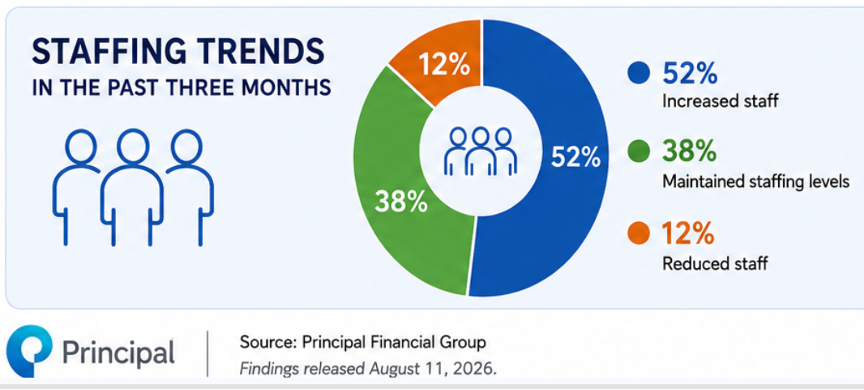
Perhaps the most compelling data came out of the Principal Financial Groupon August 11, which indicated that, in thousands of small and medium-sized businesses polled, 52% are increasing staff, while 12% are reducing. AI is enabling individuals to be more productive, which generates more revenue for the company, which allows them to hire more people. It’s a positive, virtuous cycle.
“The most compelling data came out of the Principal Financial Group indicating in thousands of SMEs polled, 52% of them are increasing staff, while on 12% are reducing.”
AI displaces tasks, not jobs. That distinction matters enormously. Your job isn’t a single thing — it’s a bundle of tasks. AI can write first drafts, summarize documents, analyze spreadsheets, generate code. It can’t negotiate, build trust, make judgment calls under uncertainty, or read a room.
But here’s the challenge… Goldman Sachs reported that professional services firms — consulting, law, accounting — face existential risk. Not because AI replaces the firm. Because junior staff trained on AI are outperforming senior partners who refuse to use it. The hierarchy is inverting.
The partner who’s been doing the job for 25 years and won’t touch an AI tool is now slower than the associate who graduated last year and runs everything through GPT. That’s not a job apocalypse. That’s a skills apocalypse. And it’s entirely preventable.
What’s Really At Risk
Let me be clear that there will be pockets of job loss coming.
Call center workers will be significantly reduced. AI voice agents are already handling customer service interactions that used to require humans. Data entry clerks, transcriptionists, entry-level paralegals doing document review, basic copywriters — these roles are being vaporized.
If your job is entirely composed of tasks that AI does faster, better, and cheaper, you have a real problem. Not a hypothetical one. A timeline one.
But here’s the thing: that’s a subset of jobs, not the entire labor market. Cognizant’s data says 93% of US jobs can be partially performed by AI — note the word ‘partially.’ That means AI handles part of the job, freeing the human to do the part that matters. The question isn’t whether your job will change. It will. The question is whether you’ll be the person who adapts or the person who gets adapted to.
What’s Really Growing
Here’s where the abundance mindset comes in. The explosion in small and medium-sized companies, entrepreneurs, and new ventures is more than compensating for the roles being compressed.
“The cost of starting a company has collapsed. The number of people who can be entrepreneurs has exploded. LinkedIn saw a 69% increase in people adding ‘founder’ to their profiles!”
LinkedIn saw a 69% increase in people adding ‘founder’ to their profiles. Half of US small businesses said AI inspired them to consider entrepreneurship. AI-related job postings grew 3.5x in two years. This is what a boom looks like.
We’re entering the era of the one-person company with AI agents. A founder who used to need a team of ten — a researcher, a writer, a designer, a bookkeeper, a customer support person — can now run all of that with AI. The cost of starting a company has collapsed. The number of people who can be entrepreneurs has exploded.
The Most Important Thing
High agency is one of the few human traits actively rewarded in the AI era. The people who win are the ones who take action, learn the tools, and put themselves in positions where AI amplifies what they can do.
Here’s what that means in practice. Use AI every day. Not for a homework assignment. For your actual work. Write with it, code with it, research with it, plan with it. Learn its limits and its strengths. Build intuition for when to trust it and when to override it. This is a skill, and skills compound.
The people who are scared of AI are the ones who haven’t used it enough to understand it. The people who are excited about AI are the ones who use it every day and see what it unlocks. Get on the right side of that line.
What This Means For You
For employees: AI is not coming for your job — it’s coming for the boring parts of your job. The person who uses AI to do their work faster and better is the person who gets promoted. The person who refuses is the person who gets replaced. Learn the tools. Today.
For entrepreneurs: The cost of starting a company has never been lower. AI handles the tasks that used to require a team. You can be a one-person company with the output of a ten-person team. The barrier isn’t technology — it’s whether you have an idea worth building.
For parents: Your kids need AI fluency the way my generation needed computer literacy. Not because AI will replace their jobs — because AI will transform every job they’ll have. Teach them to use it, question it, and build with it.
For investors: The job apocalypse narrative creates mispriced assets. Companies that are adapting to AI are seeing employment growth. Sectors that are fighting AI are the ones at risk. Follow the data, not the headlines.
For policymakers: Don’t legislate against AI adoption — you’ll just export the jobs to the countries that embrace it. Do invest in retraining. Do protect the workers in genuinely at-risk categories. But recognize that in the NBER survey, more than half of 6,000 executives across four economies said AI is already changing their workforce needs. The question is whether your economy adapts fast enough to capture the upside.
In Abundance,
Peter H. Diamandis, MD
Peter, I was retired until AI pulled me back in, and none of this will touch me directly. I think about it every day anyway because of my 15-year-old grandson, so please bear with a long comment.
In earlier Moonshots episodes you and your mates admitted that job losses are likely. This post and your recent Moonshots episode say the opposite, and I don't think the data supports the flip. Your numbers are real, but they do not show all that you claim. Studies of companies that adopt AI only see the adopters, and adopters grow by taking business from companies that didn't. The WEF report you cite also says 41% of employers plan to cut staff wherever AI can do the work. The New York Fed has recent graduate unemployment at 5.7% as of June against 4.3% for everyone, which almost never happens. PwC, whom you cite, surveyed a thousand financial services executives in May and found nearly eight in ten expect their workforce to shrink by at least 20%. None of this shows up as layoffs. Companies just stop writing the entry-level posting.
The one-person company is the clearest job loss argument in your post. One founder doing the work of ten is nine people never hired. The bigger problem is that every number in your post is a snapshot, and the snapshot is taken at the very start of the curve. Most companies are still experimenting, and agents that actually do the work barely exist in production yet. Saying there is no job loss today is like measuring the tide at the first ripple of what you yourself call "the coming tsunami." The question is what these numbers will look like two years from now, when the tools do most of the job instead of part of it. Your answer is that everyone can become a founder and the skeptics simply cannot picture the new jobs. Fair enough. I just don't think imagination is what holds people back. In all my years of running a company and working inside large ones, I saw that plenty of smart, capable people have no interest in starting a business and no appetite for the risk. They would rather put in a day's work and go to their kid's soccer game, and there is nothing wrong with that.
So the question is psychology, not capability. If you believe AI changes human psychology, say why. My grandson has been a techie tinkerer since the day he was born, so I push him toward AI and buy him the hardware to explore it. Learning the tools is the right advice for him. You and your Moonshots mates have spent a year on the pod describing the new chairs, and I believe they are real. They are built for kids who are fascinated with this stuff. Many kids I see have other things that interest them more, at least for now, and I don't see a chair waiting for them when the old ones are gone.
It's great to be optimistic, but treating AI fluency like a weekend software update glosses over a deep structural problem. Schools spend over a decade drilling people to follow rubrics, wait for instructions, and protect themselves from risk. That is the exact opposite of what it takes to work alongside AI or build a venture.
AI stumbles the second there's no pre-existing script to follow, and since traditional education trains humans to look for a roadmap rather than invent one, expecting a sudden pivot to entrepreneurship ignores the heavy mental hurdle of unlearning a lifetime of compliance. You can't just download agency; the friction of operating without a manual is why most people freeze up. That's why it's crucial that the youth start learning this now.