


TLDR: The poorest person alive today lives better than the richest king of 500 years ago. Instant communication, food year-round, air conditioning, toilets, AI in your pocket. This newsletter asks: when does the majority of humanity get what today’s millionaires have? The answer is sooner than you think.
King Louis XIV of France had 200 servants, ate whatever he wanted, and controlled the most powerful nation on Earth. He died at 76 of gangrene in a palace that smelled of sewage because indoor plumbing didn’t exist. His doctors bled him with leeches. His entertainment was whatever musicians happened to be in Versailles that evening. His knowledge was whatever books his court could acquire, which was maybe a few thousand volumes.
Today, a person earning minimum wage in the United States has a smartphone that connects to the entirety of human knowledge. They have access to more music than Louis XIV could have imagined in 100 lifetimes. They have air conditioning. They have a toilet that flushes. They have food from every continent delivered to their door in 30 minutes. They carry an AI in their pocket that can answer any question, translate any language, and diagnose symptoms better than any physician alive in the 17th century.
The king had power. You have abundance. And abundance is better.
So here’s the question I want to investigate: when does the majority of humanity get what today’s wealthy have? Not the minimum-wage baseline. The millionaire baseline. The personal physician. The private school. The house cleaner. The private flight. The chef. The personal assistant. When do those things demonetize to near-zero?
“The king had power. You have abundance. And abundance is better.”
WHAT A $1M/YEAR HOUSEHOLD HAS TODAY
Here’s the inventory of a household earning $1 million or more per year in 2026:
Best healthcare: concierge medicine, full-body MRI scans, continuous glucose monitoring, personal physician on call, Fountain Life membership, genetic testing, preventive oncology screening
Best education: private school ($40-60K/year), personal tutors for every subject, SAT/college prep coaches, language instructors, coding camps
Private aviation: fractional jet ownership or charter, fly anywhere on demand
Beautiful cars: Tesla, Mercedes, Range Rover, refreshed every 2-3 years
Primary home + vacation home: 5,000+ sq ft, smart home systems, pool, gym
Support staff: house cleaner, personal assistant, nanny, landscaper, private chef or meal delivery
Entertainment: premium streaming on every platform, live events, concerts, travel
Financial advisor and personal CPA
Personal trainer and nutritionist
Executive health screenings quarterly
WHEN IT DEMONETIZES
Here’s my projection for when each of these becomes accessible to the majority of humanity, driven by exponential technologies:
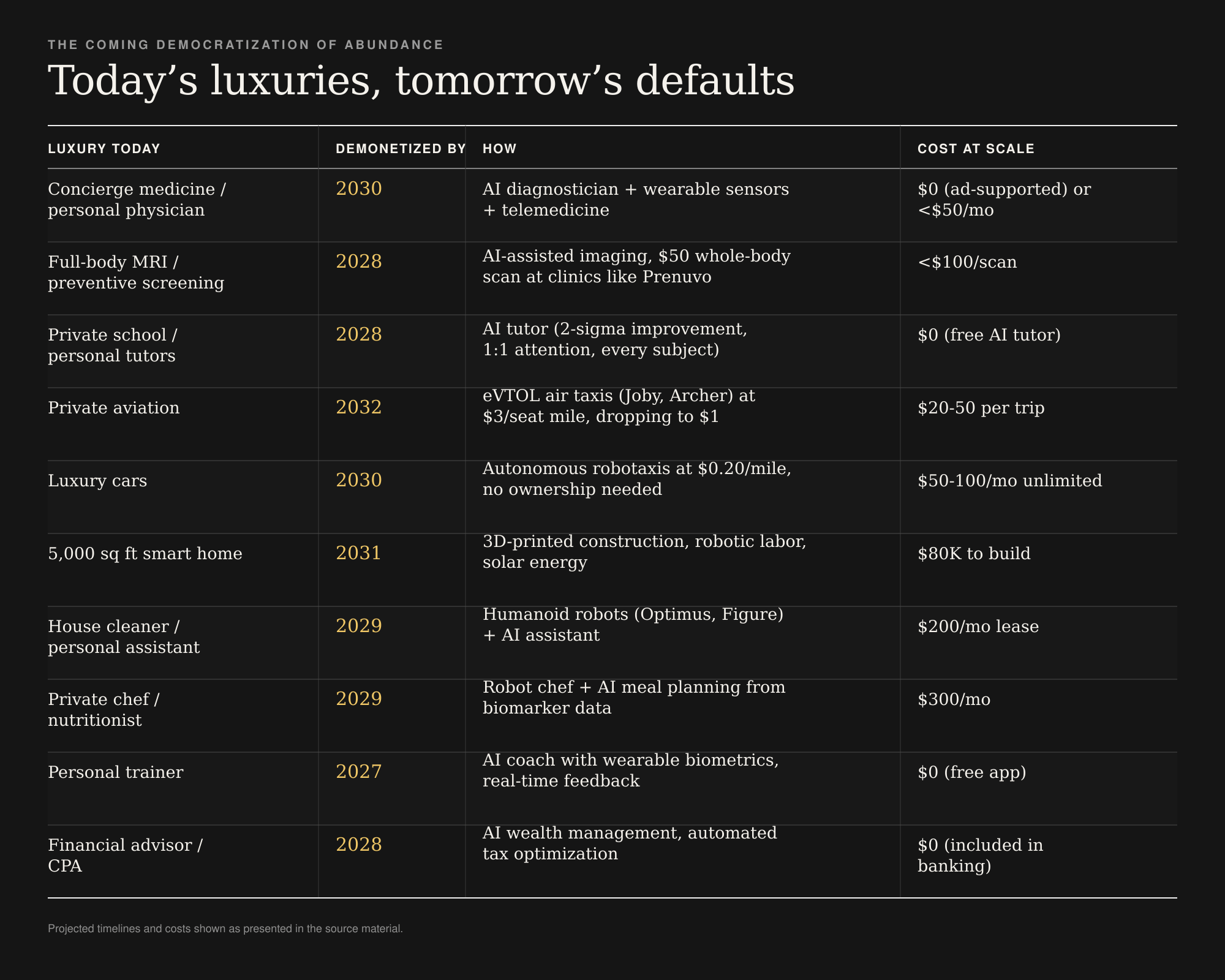
ELON’S UNIVERSAL HIGH INCOME
Elon Musk has spoken about universal high income. Not universal basic income. Universal HIGH income. The distinction matters. UBI is a floor. UHI is a ceiling that keeps rising. The idea is that AI and robotics reach a point where the marginal cost of producing anything approaches zero, and the economic surplus is so enormous that everyone has access to more than enough.
When humanoid robots build houses at $80K, when AI doctors diagnose better than any human physician at zero marginal cost, when robotaxis replace car ownership at $50/month unlimited, when AI tutors deliver personalized education that outperforms Andover and Exeter for free, the millionaire lifestyle doesn’t trickle down. It collapses down. The cost structure that makes these things exclusive breaks apart.
“The millionaire lifestyle doesn’t trickle down. It collapses down.”
THE TIPPING POINT: 2031
If I had to pick one year when the majority of humanity crosses the millionaire threshold in terms of access, I’d say 2031. Here’s why. By 2031, four technology curves converge simultaneously. AI tutors hit 2-sigma educational outcomes for free. Humanoid robots cost less than a car and can clean, cook, and maintain a home. Robotaxis make car ownership unnecessary. And AI diagnostics plus wearable sensors deliver physician-grade healthcare to anyone with a phone.
The last mile is energy and housing. Solar plus battery storage crosses the threshold where electricity is effectively free in most of the world by 2030. 3D-printed construction and robotic labor bring the cost of building a quality home below $80K by 2031. At that point, the four basics of life (food, shelter, energy, healthcare) plus the four luxuries (education, transport, assistance, entertainment) are all demonetized.
China’s billion-agent simulation we discussed on the pod is a preview. When you can simulate an entire society, you can simulate the economic models that make universal high income work. The question isn’t whether the abundance arrives. It’s whether we distribute it.
WHAT THIS MEANS FOR YOU
If you’re an entrepreneur: Every item on that table is a company. The robot chef, the AI tutor, the $80K home, the robotaxi network. Pick one and build it.
If you’re an investor: The companies demonetizing these categories are the next trillion-dollar opportunities. The firm that makes housing 10x cheaper owns a bigger market than any software company in history.
If you’re an executive: Your employees will soon have AI assistants, robot helpers, and free education. The workplace you’re managing today won’t exist in 5 years. Start planning for it.
If you’re a parent: Your kids will have access to better education, healthcare, and transportation than any billionaire’s children have today. Your job is to teach them adaptability, curiosity, and purpose. The skills layer is free. The wisdom layer is not.
If you’re a policymaker: The question isn’t how to tax the wealthy. It’s how to accelerate the demonetization so the majority gets there faster. Every regulation that slows AI, robotics, or autonomous transit delays the arrival of abundance for the people who need it most.
Louis XIV died of gangrene because the best medicine of his era was leeches. Your children will live in a world where the best medicine is an AI that reads your genome, monitors your biomarkers, and prevents disease before it starts. They will have a robot that cooks, cleans, and runs errands. They will have a tutor that knows their learning style better than they do. They will have a car that drives itself. They will have access to every piece of music, every film, every book, every course, every conversation ever recorded.
They will be kings. Everyone will be kings. The only question is when.
To a future of abundance,
Peter
> If you’re a policymaker: The question isn’t how to tax the wealthy. It’s how to accelerate the demonetization so the majority gets there faster. Every regulation that slows AI, robotics, or autonomous transit delays the arrival of abundance for the people who need it most.
I know Peter is not a blind optimist, but this is a very narrow view of regulation. Sure, slowing AI or robotics "for no reason" would be cruel and pointless. However, what good is a robotic chef if you don't have clean water to cook with? "Regulations" are never inherently bad (or good). They are calculations; they can have unintended consequences, but they can also prevent tragedies that would otherwise happen. And if a regulation helps people now, but happens to slow down a bit of the technology, then that's actually still good.
xAI was in such a hurry to build their data center that they pulled in methane turbines to generate electricity when the grid didn't hook up fast enough. These were illegal and unpermitted, they emit huge amounts of greenhouse gases, and they were poisoning the air of nearby communities. Only under legal duress did they finally agree to remove them... over the next YEAR--when they never should have been there in the first place. https://www.engadget.com/2228277/spacexai-says-it-will-take-a-year-to-fully-remove-unpermitted-gas-turbines-from-its-mississippi-data-center/
If Abundance is truly to benefit the poorest among us, we have to reach it without first harming them further. Government is the only entity big and powerful enough to counteract human greed, which wants to do everything now as fast as possible and doesn't, deep down, care if *other* people get hurt. I'm not saying government is perfect--it's also humans who have greed--but democratic governance is the best weapon we've found to protect the masses from reckless power. And one of the best ways to do that might be to tax the wealthy a little. If they want the public to invest in their companies (which they manifestly do, since they're seeking to change rules to get them included in index funds sooner), then they need to accept the public's restrictions in the public's interest.
"The king had power. You have abundance. And abundance is better."
No it isn't. Power over your own life is better, and your own list proves it. A physician who monitors you, a tutor who teaches you, a chef who feeds you, a car that drives you, an income that shows up whether you do anything or not. Nothing on that list is a king. A king gives orders. Everything on your list just arrives. You're describing a very comfortable subject and calling him a king.
And we don't have to guess how this turns out, because we've already run this experiment four times. Printing made reading nearly free, and it helped the people who already knew how to read. Food got cheap, and we got obesity. Information got free, and people can barely hold a thought for two minutes. Entertainment got free, and it ate everyone's evenings. Every single time, the people who were prepared used the abundance, and the abundance used everyone else. The thing that separated the two groups was never the price. It was whether anyone ever taught them what to do with it. Your 2031 is round five, and you're predicting the results of the people who were always going to be fine.
Here's the darker problem. People fall apart when what they do stops mattering to how their life turns out. Now walk through your 2031. The food arrives. The house gets built. The robot cleans. The tutor teaches. The car drives. The check comes no matter what. You've disconnected effort from outcome in every corner of a person's life and you're calling it paradise. Look at the richest countries on earth right now. They are not the happiest. They're medicated, anxious, and lonely. More delivery is not going to fix that. More delivery is what's causing it.
And here's the thing, Peter. You know all this. You wrote it in this very piece: "The skills layer is free. The wisdom layer is not." That's the whole ballgame in nine words. And you gave it one line, aimed it at parents, and then told policymakers to hurry up and speed up the free layer.
Why does everyone do that? Because abundance can be sold and agency can't. Delivering things to people asks nothing of them, so it makes a great pitch, a great company, a great newsletter. Developing people requires them to actually show up and do something hard, and nobody's figured out how to get rich on that. That's why all the money is going one direction. Populations don't get consulted about any of this. They get led to the trough by people who make money until the trough is full, but it’s never enough.
A tutor that shows up before the kid knows what to ask for isn't a school. It's a vending machine. The missing piece in your 2031 isn't another cost curve. It's the thing that develops the person: something that asks before it answers, helps people figure out what they're actually trying to do, writes it down where they own it, and succeeds when they need it less. Nobody's building it, because a business that succeeds when its customers need it less is not a sustainable business. So what we do is serve up abundance which is supposed to feel like agency, but is actually just more dependency.