

TLDR: Add up Elon’s SpaceX gift to America’s kids and Anthropic’s new Public Benefit Fund, and you get roughly two days of America’s paychecks. The size of the gap tells you what has to happen next. My bet is on ownership that compounds.
Two weeks ago, Anthropic filed its S-1 under the ticker ANT, at a valuation that reports put between $1.5 trillion and $2 trillion. A week earlier, they told the world it would give a chunk of the company away, and two more announcements were made within 72 hours. Read together, they’re the first serious attempt to hand ordinary Americans a piece of the AI economy.
FOUR DAYS IN OCTOBER
On Saturday, October 18, Anthropic announced a Public Benefit Fund seeded with 5% of its shares (subject to stockholder approval), with another 2% at the board’s discretion for every 50% rise in value above a baseline. Add the co-founders’ pledges and the employee matching program, and roughly 20% of the company is pointed at the public good. It has already committed $200 million to studying AI’s impact on the labor market.
The next day Elon announced he would give one share of SpaceX to every American child next year, delivered into their Trump Accounts. In his words: “This will be the first of many.” Brad Gerstner called it “the largest philanthropic gift in history.”
On Wednesday the President posted on Truth Social that companies building data centers should pay the host community “and/or individuals within the community” a “dividend.” No executive order exists yet, per 24/7 Wall St, and no dollar figure was named.
Michael Dell set the precedent last December with $6.25 billion to put $250 into the accounts of 25 million kids. In the background sits Senator Sanders’ American A.I. Sovereign Wealth Fund Act (S. 4825), which would take a one-time 50% stake in major AI companies and build a fund he estimates at $7 trillion, with a dividend starting at more than $1,000 per American per year.
We recorded Moonshots EP #304 with Chamath Palihapitiya the morning after Elon’s post. Chamath called Anthropic’s move “really the better version of the giving pledge.”
THE MATH, STEP BY STEP
Start with Elon. The Census counts about 72 million Americans under 18. SpaceX closed the prior Friday at $146.03, so 72 million shares comes to $10.5 billion. Elon holds roughly 4.8 billion shares, so the gift is about 1.5% of his stake. Trump Account rules lock donated stock for five years or until the end of the year the child turns 17, whichever comes first (CNBC).
Now Anthropic. Five percent of a $1.5 trillion company is $75 billion. At $2 trillion it’s $100 billion. That’s an entire Alaska Permanent Fund ($91.9 billion as of June 30, 2026) created in a single board vote.
Now the denominator. Americans earned $15.7 trillion in wages and benefits in 2025, according to the Bureau of Economic Analysis. That works out to about $43 billion a day. Elon’s $10.5 billion plus Anthropic’s $75 billion is $85.5 billion, or about two days of pay.
Paying each of the 269.8 million American adults $10,000 a year would cost $2.7 trillion, every year. As I said on the pod, “Even the biggest fortunes on Earth are just one-time paychecks.”
“A paycheck gets spent. Shares compound.”
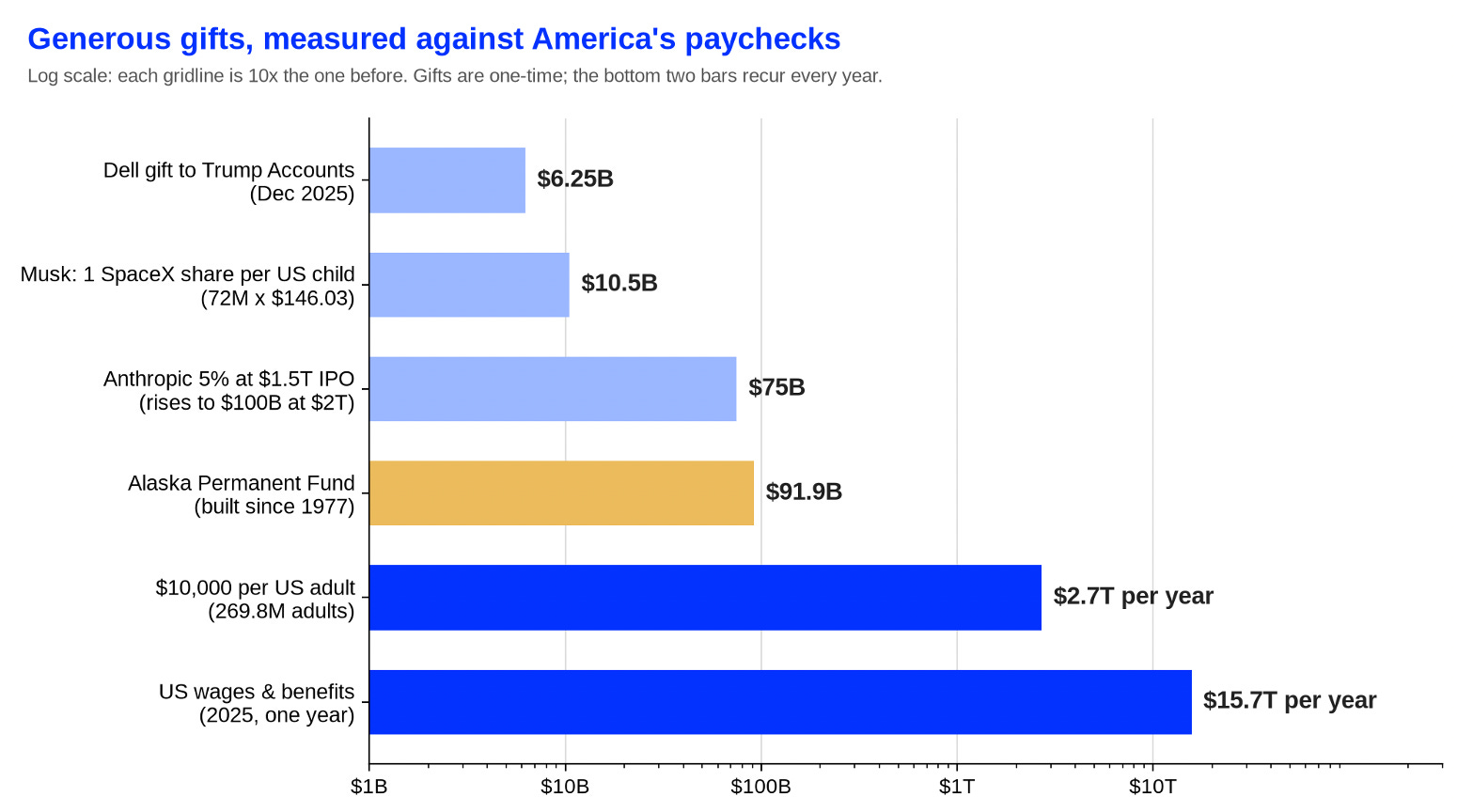
Sources: CNBC (Musk gift, Oct 19, 2026); White House (Dell gift, Dec 2025); Anthropic and NPR (5% at a reported $1.5T IPO valuation); APFC 2026 Annual Report; U.S. Census Vintage 2025 (adults 18+); BEA via FRED (2025 compensation of employees).
THE FORK: OWNERS OR RENTERS
I’ll concede the risk in one line: Pew found 71% of US adults expect AI to mean fewer jobs over the next two years, and if the gains pool with a small circle of shareholders, the backlash will be ferocious.
When I interviewed Elon at the Austin Gigafactory in January, I asked him how we get to universal high income without social unrest. His answer: we’ll “have universal high income and social unrest. That’s my prediction.”
I made my own prediction over lunch with my friend Bill Shatner last week. During COVID, Washington sent each eligible adult $3,200 in three rounds of checks. When unrest arrives, the government will reach for the same lever. As I told Bill, “My prediction is we’re gonna get to $3,000 a month being paid by the government to everybody.”
That’s the renter’s path. You get a check funded by printed money, and you own nothing that grows.
The owner’s path gives you a slice of the machines. On EP #304 I argued that “ownership beats handouts,” because a paycheck gets spent and shares compound. Alex Wissner-Gross put his finger on the missing piece: America has never built the muscle for “universal basic equity.” Governments know how to tax income and mail checks. Moving shares into 72 million accounts is new, and Trump Accounts are the first real plumbing for it, with more than 60 million children auto-enrolled on October 1.
WE’VE DONE THIS BEFORE
In 1862 Lincoln signed the Homestead Act. The most productive asset of the 19th century was land, and the federal government handed it out in 160-acre parcels to anyone willing to work it. About 1.6 million claims succeeded, covering 270 million acres, roughly 10% of all the land in the United States. Families that had never owned anything built farms, and the towns around those farms became the backbone of a new middle class.
“The most productive asset of the 19th century was land. In this century it’s compute.”
A century later Alaska ran the same play with oil. The state made its first deposit of $734,000 into the Permanent Fund in 1977. The first dividend check, in 1982, was $1,000. This year every eligible Alaskan received $1,200, and the fund sits at $91.9 billion. Alaskans defend that dividend like a birthright because it belongs to them.
The lesson from both: give people title to the productive asset early, then let time do the work.
PAY THE NEIGHBORS
The data center fight is where this gets real first. On our October 22 episode I said it plainly: “Pay the neighborhoods... make it so that communities are battling to have you built in their backyard.”
Cash alone won’t do it. In Hazle Township, Pennsylvania, residents rejected an offer of $10,000 per resident for an Amazon Web Services campus this month. In De Soto, Kansas, Digital Realty offered $1,000 per household per year in utility and tax credits for ten years to host a 600-megawatt campus. Nebius’ chief revenue officer, Marc Boroditsky, told CNBC that “it’s not crazy to consider something like that.”
If I sat on a town council, I’d ask for a lasting stake: electric bills cut in half or a share of revenue that rises as the campus grows. One-time payments buy a vote. A stake builds a constituency.
WHY I’M BULLISH
AI and robotics are driving the cost of goods and services toward zero. As I told Shatner, “eventually, the cost of everything is going to plummet driven by SI and robotics.” So a modest ownership stake buys more every year. A $1,200 dividend in a world where intelligence and energy are near-free is worth far more than it looks today. Elon put it his own way in our January conversation: “the future currency will essentially just be wattage.”
On the pod I predicted this is “just the very beginning of the process by which these large hyperscalers start having sort of an expectation that... part of their equity is gonna be distributed.” I’ll go further. By 2030 a public equity pledge at IPO will be table stakes for any frontier AI company that wants social license. The one change I’d push for is longer lock-ups. I wish Elon had locked those shares until the kids are much older, and I love Chamath’s idea of a ‘birth dividend’ that stays invested until 65.
WHAT THIS MEANS FOR YOU
If you’re an entrepreneur: Put community ownership in your cap table early. The founders who share upside with the people affected by their product will win permits and talent faster than the ones who don’t.
If you’re an executive: When you site a data center or a factory, walk into the first zoning meeting with a stake on the table. Hazle Township just showed that a big check arriving late gets rejected.
If you’re an investor: Read Anthropic’s S-1 closely. A 5% grant plus 2% more per 50% gain is real dilution, and it may soon be the going price of a social license across the sector.
If you’re a student: Open a brokerage account this year and buy a sliver of the companies building AI. Owning even a few shares of the systems reshaping entry-level work changes how you see your future.
If you’re a parent: Claim your child’s Trump Account in the official app. Auto-enrollment created the account, but a parent still has to claim it before gifts like Elon’s share or Treasury’s $1,000 seed (for eligible kids) can land.
My challenge to you this week: count how many shares of the AI economy your family owns today, then decide what that number should be by next October.
To a future of abundance,
Peter
The full conversation with Chamath, Dave, Salim and Alex is on Moonshots EP #304. Send it to someone who thinks AI only takes.
P.S.
This section is brought to you by Circle.
What happens when your customer isn’t a person, but an AI agent with a wallet?
On Thursday, November 5 at 3:00 PM ET, Circle’s Marlowe Johnson and Danny Organ are hosting a free one-hour session on agentic commerce: how to build products that AI agents can discover, pay for, and transact with on their own, using wallets, payments, and programmable USDC flows. They’ll also trace how trust and money movement got us to a world where agents are economic actors.
If you’re building anything that agents will one day buy from or sell to, this is worth the hour.
Peter, is your world limited to American society alone? Do you believe that the benefits of ownership oof AI built on global data and open source knowledge pools on the internet, should rightfully (?), belong ONLY to American children?
Excellent work. This is something for everyone to consider. Two important ideas: compounding and ownership.